Common Types of Hammers and Their Uses – A Guide to Choosing the Right Tool
In every toolbox, from household kits to professional workshops, the hammer is one of the earliest and most indispensable hand tools. No matter how technology advances, mechanical impact still plays a crucial role in assembling, shaping materials, or demolishing structures. However, not everyone fully understands the different types of hammers and their specific uses. Confusing a metalworking hammer with a wood-nailing hammer can lead to damaged surfaces or, more dangerously, hammer head fractures.
To achieve the highest efficiency, tradespeople need to equip themselves with a high-quality, genuine hammer suited to their specific tasks. Claw hammers, rubber mallets, sledgehammers, and ball peen hammers each feature distinct lever designs and surface materials to intelligently transmit or absorb impact forces.
With extensive experience in providing mechanical supplies, Ha Thanh Co., Ltd. HCM Branch will offer a detailed overview of the world of hammers. The following article will help you clearly distinguish their functions, enabling you to make accurate and cost-effective tool purchasing decisions.
Contact us now: 0902 8888 02
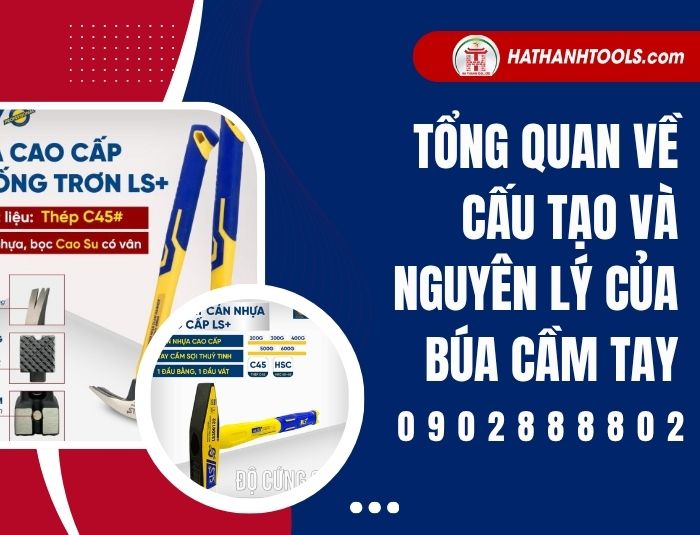
Overview of the Structure and Principles of Hand Hammers
Basic Structure of a Specialized Hammer
Regardless of its peculiar shape, every hammer consists of two main components: the Head and the Handle.
-
Hammer Head: Typically made from high-strength forged steel, rubber, plastic, or copper. The head is divided into a striking face (for applying force) and an opposite end (which might feature a nail puller claw, a ball end for metal shaping, or a splitting end).
-
Hammer Handle: Functions to create leverage, amplifying the striking force. Handles can be made of natural wood, fiberglass with rubber grips for vibration absorption, or solid steel cast integrally with the hammer head.
Why Shouldn't You Use One Hammer for Everything?
Many people habitually grab the nearest hammer for any task. If you use a steel hammer on ceramic tiles, the tiles will shatter. If you use a rubber mallet to drive nails, the rubber will absorb most of the impact, and the nail won't penetrate the wood. Using the wrong type of heavy-duty steel hammer not only damages the material but can also cause dangerous backlash injuries to your wrist.
Contact us now: 0902 8888 02
Detailed Types of Hammers and Their Practical Uses
Claw Hammer – The Carpenter's Right Hand
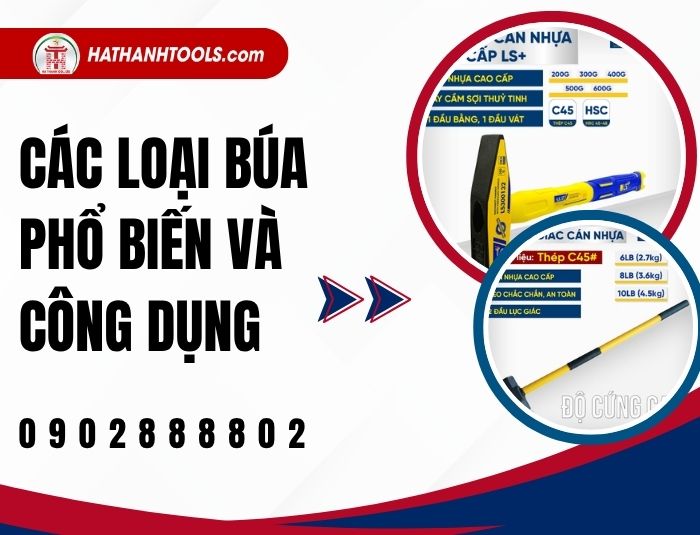
Leading the list of common hammer types and their primary uses is the Claw Hammer. It features a flat striking face for driving nails and a curved claw on the opposite side, forming a V-shaped slot.
-
Function: Primarily used for driving nails into wood and utilizes the leverage of the claw to pry out bent or misplaced nails.
-
Applications: Indispensable in carpentry, building formwork, and a must-have item in any household toolkit.
Rubber Mallet / Plastic Hammer – Perfect Surface Protection
Unlike steel, the hammer head is cast from solid rubber or synthetic PU plastic. When purchasing a good value rubber mallet, you'll notice its high elasticity.
-
Function: Delivers a firm, solid strike without scratching, breaking, or deforming the contact surface. The impact force is evenly distributed.
-
Applications: Especially crucial for tile installers, window and door frame assemblers, or for gently tapping furniture joints together without leaving marks.
Contact us now: 0902 8888 02
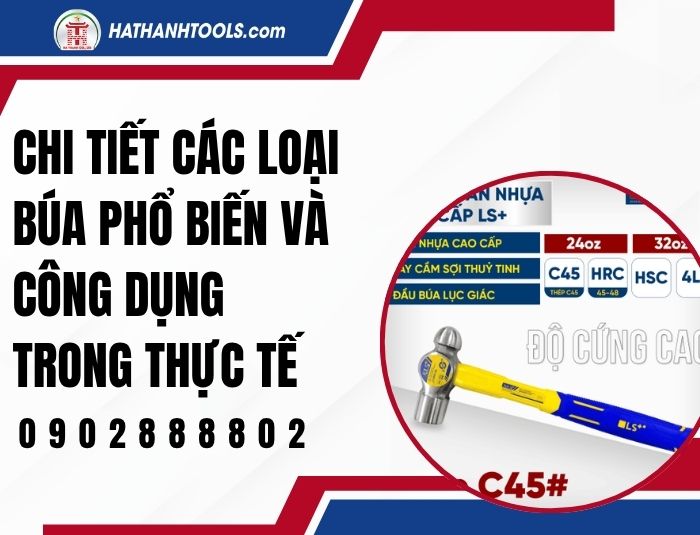
Ball Peen Hammer – The Metalworking Specialist
The Ball Peen Hammer has a flat striking face for general use and a rounded, hemispherical face (like half a ball bearing). The hammer head is extremely hardened through tempering.
-
Function: The ball end is used to evenly distribute force for peening rivets and shaping thin sheet metal into desired curves.
-
Applications: A favorite among auto body workers, blacksmiths, and in workshops for fabricating mechanical parts.
Sledgehammer – Raw Demolition Power
As the name suggests, the Sledgehammer is massive, with head weights ranging from 3kg to 10kg, accompanied by a long handle designed for two-handed swinging.
-
Function: Delivers incredibly powerful demolition force.
-
Applications: Primarily used for demolishing brick and concrete walls, driving large wooden stakes into the ground, or breaking up large rocks in civil engineering projects like bridge and road construction.
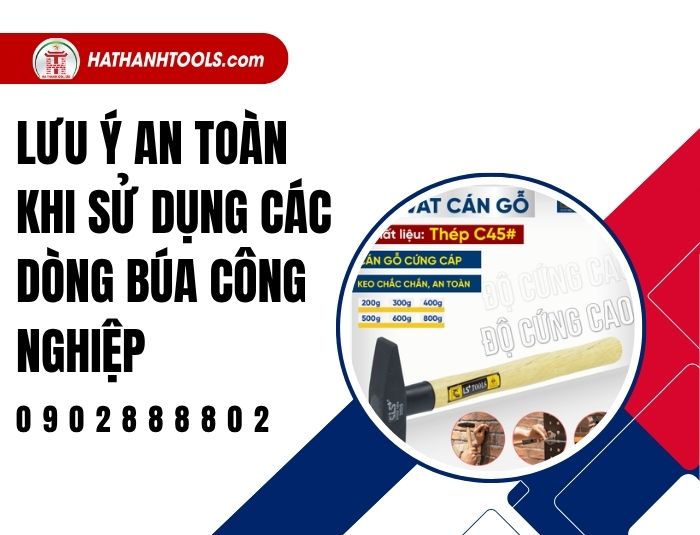
Safety Precautions When Using Industrial Hammers
Always Check the Handle-Head Connection
Before swinging, gently shake the hammer to ensure the head is not loose. If the wooden handle has shrunk, causing a loose head, the metal head could fly off like a projectile during a swing, posing a fatal risk. Soak the handle in water to let the wood expand or drive in metal wedges to secure it.
Correct Hammer Grip Technique
Do not grip too close to the hammer head (short grip) as this reduces leverage. Grip at approximately one-third of the way down the handle from the butt. Relax your wrist, swing the hammer up, and let the weight of the imported multi-purpose hammer fall naturally onto the striking point. This allows for a more powerful strike without straining your wrist.
Contact us now: 0902 8888 02
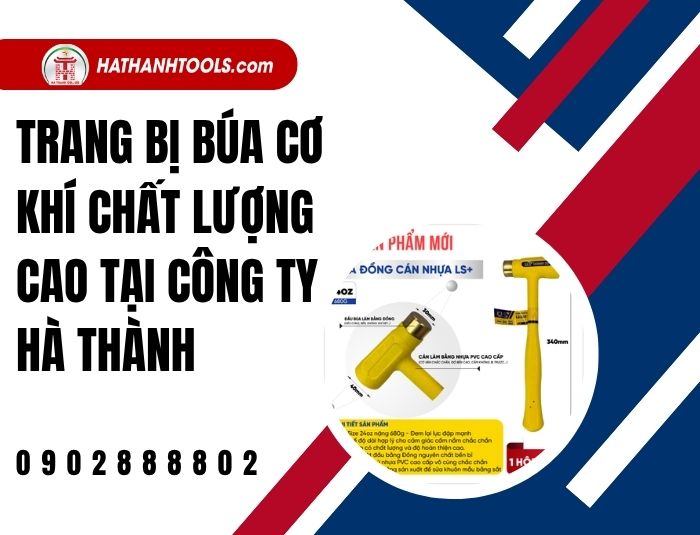
Equip Yourself with High-Quality Mechanical Hammers at Ha Thanh Company
Understanding the common types of hammers and their uses is foundational, but to maximize efficiency, you need truly high-quality tools. Ha Thanh Co., Ltd. HCM Branch is proud to offer mechanics and households the finest forged steel hammers and premium TPR rubber mallets on the market.
Products distributed by Ha Thanh consistently feature fiberglass handles with vibration dampening, and heat-treated steel heads resistant to chipping and fracture. When you visit us, you'll receive expert advice to help you select the perfect tool that fits your hand, provides adequate force, and precisely meets your work requirements.
Don't let substandard hammers injure your hands or damage your materials. Contact Ha Thanh Co., Ltd. HCM Branch immediately to equip yourself with professional-grade striking and hammering tools!
Contact us now: 0902 8888 02
10 Frequently Asked Questions About Hammer Types and Uses
1. Among common hammer types and uses, which one should a household buy?
Answer: Households only need a medium-sized claw hammer (around 16oz). It's sufficient for driving nails for hanging pictures and removing old nails, covering about 90% of home needs.
2. Why use a rubber mallet for laying tiles?
Answer: Rubber mallets are soft and deliver a firm strike to embed tiles securely into the underlying cement without cracking or scratching the ceramic surface of the tile.
3. What is a ball peen hammer used for?
Answer: The Ball Peen hammer is specialized for metalworking. Its ball end is used for shaping sheet metal or for peening rivets to fasten metal pieces together.
4. Can I use a claw hammer to strike a cold chisel?
Answer: No, you shouldn't. A claw hammer's head is designed for driving nails (soft metal). Cold chisels are typically very hard; striking one with a claw hammer can chip the hammer face. It's better to use a small sledgehammer or a flat-faced mechanic's hammer.
5. Are wooden or fiberglass hammer handles better?
Answer: Fiberglass handles are superior. They are lightweight, highly resistant to bending without breaking like wood, and better at absorbing shock, preventing hand numbness during heavy strikes.
6. How to deal with a rusty hammer head?
Answer: You can use sandpaper to remove the rust, then wipe the steel surface with a cloth dipped in machine oil or spray with WD-40 to create a protective layer against oxidation.
7. Why do nails often bend when hammered?
Answer: This is usually because you're not swinging the hammer perpendicular to the nail head, or the nail is too small for the force of the swing. Start by gently tapping to position the nail, then gradually increase the force while keeping the hammer perfectly vertical.
8. What is the typical weight of a sledgehammer?
Answer: Sledgehammers used for breaking concrete or driving piles commonly weigh 3kg, 5kg, or 8kg, and can go up to 10kg depending on the user's strength.
9. Does Ha Thanh Company sell one-piece forged hammers?
Answer: Yes, Ha Thanh Co., Ltd. HCM Branch distributes one-piece forged steel hammers with unbreakable handles and premium, anti-slip rubber grips.
10. Can PU plastic hammers be used for driving nails?
Answer: Absolutely not. PU plastic is very flexible and elastic; striking a nail with it would deform the plastic face and prevent sufficient force transmission to drive the nail into the wood.
Contact Information
-
Ha Thanh Co., Ltd. HCM Branch
-
Hotline: 0902 8888 02
-
Address: 35 Nguyen An Khuong, Chợ Lớn Ward, Ho Chi Minh City
-
Email: cskh@hathanhls.com
-
Tax Code: 0100108529-006
-
Website: https://hathanhtools.com