How to Use Rivet plierss? A Guide to Standard Riveting Techniques
Within the category of specialized hand tools for mechanical assembly and aluminum-glass work, the rivet pliers (also known as a pop rivet tool) is an indispensable device. However, for newcomers or DIY enthusiasts at home, the question of "how to use a rivet pliers" is a common query. If you don't understand how to select the correct nosepiece size, how to position the tool perpendicular to the surface, or the proper squeezing force, you risk jamming the rivet mandrel, deforming the rivet head, or even damaging the tool's internal jaws. Understanding how to use a rivet pliers will enable you to create strong, aesthetically pleasing, and labor-saving connections.
With years of experience in distributing professional mechanical tools, Ha Thanh Co., Ltd. - Ho Chi Minh City Branch will thoroughly answer your questions about how to use a rivet pliers. From the principle of construction and how to change nosepieces to the process of squeezing and releasing rivets, users will gain precise skills to operate the rivet pliers smoothly in all application conditions.

Contact us now: 0902 8888 02
Understanding the Construction Before Learning How to Use a Rivet pliers
Detailed Look at the Rivet pliers's Mechanism
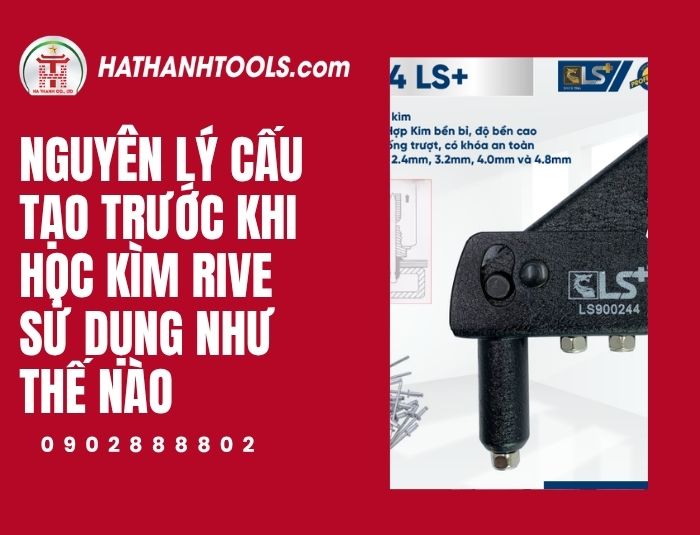
In terms of general construction, to understand how to use a rivet pliers, you need to know that the device consists of: two lever handles, a spring-loaded ejection system, a barrel housing a hardened steel jaw assembly, and interchangeable nosepieces. When you squeeze the handles, the internal jaws of the rivet pliers grip the steel mandrel of the rivet and pull it backward. This pulling force causes the aluminum shell of the rivet to expand, clamping the two material layers together until the steel mandrel reaches its maximum tensile strength and breaks off.
By understanding this mechanism and knowing how to use a rivet pliers, users can easily achieve:
-
Control hand force to squeeze and release the rivet pliers at the right pace.
-
Optimize joint tightness without scratching materials with the rivet pliers's nose.
-
Prevent rivet mandrels from jamming or protruding due to improper mandrel ejection.
-
Save maintenance costs by knowing how to keep the rivet pliers jaws durable.
Preparation Steps Before Operating a Rivet pliers
Whether you are using a rivet pliers to assemble a metal shelf, build a truck bed, or repair a corrugated roof, mastering the preparation phase is fundamental to knowing how to use a rivet pliers effectively:
-
Prepare a drill bit with a size equivalent to the rivet's diameter.
-
Drill pilot holes through the two pieces of material to be joined, ensuring they are perfectly aligned.
-
Determine the mandrel's cross-section to select the most suitable nosepiece for the rivet pliers.
-
Ensure the rivet pliers's mandrel collection chamber is completely empty of old steel shavings.
-
Adopt a comfortable posture that allows you to squeeze the rivet pliers handles together with maximum force.
With all preparations complete, applying the rivet pliers in practice will become extremely smooth and highly productive.
Contact us now: 0902 8888 02
Practical Steps: How to Use a Rivet pliers Correctly?
Step 1: Select and Install the Nosepiece for the Rivet pliers
The most critical step determining the success of how you use a rivet pliers is selecting the nosepiece. Each rivet pliers typically comes with four interchangeable nosepieces (sizes 2.4, 3.2, 4.0, 4.8mm). Insert the steel mandrel of a rivet into each nosepiece. The one that allows the mandrel to pass through snugly is the correct one. Remove it with the wrench and securely install it onto the rivet pliers's main barrel:
-
A loose nosepiece will cause the rivet to bend to one side when you squeeze the pliers.
-
A tight nosepiece will jam the steel mandrel, preventing the rivet pliers from releasing the rivet after it breaks.
-
Always use the wrench to tighten the nosepiece securely to prevent wobbling under high pulling force.
At Ha Thanh Co., Ltd. - Ho Chi Minh City Branch, our rivet pliers models come equipped with a multi-functional wrench integrated into the handle, making the process of changing nosepieces extremely convenient.
Step 2: Load the Rivet and Position the Rivet pliers on the Material
Continuing our lesson on how to use a rivet pliers, insert the aluminum head of the rivet into the pre-drilled hole in the material. Fully open the rivet pliers's handles, then insert the steel mandrel of the rivet into the nosepiece. Push the rivet pliers firmly until the nosepiece face is flush and presses tightly against the rivet head. Hold the pliers perpendicular (90 degrees) to the surface.

Contact us now: 0902 8888 02
Step 3: Squeeze to Break the Mandrel and Eject the Rivet pliers
Squeeze the rivet pliers handles together decisively. If the rivet is long, you may need to release the handles, reposition the pliers closer to the rivet, and squeeze again until you hear a "click" – the mandrel has broken off. The final secret to mastering how to use a rivet pliers is: immediately after the rivet breaks, turn the rivet pliers's nose downwards and open the handles to allow the broken mandrel piece to fall out.
-
Never insert a new rivet into the pliers if the old mandrel piece is still stuck inside.
-
Thoroughly ejecting the mandrel is the golden rule to prevent the rivet pliers's jaws from jamming.
-
Ensure the joint is flush, the aluminum shell is evenly expanded, and the rivet pliers does not dent the material.
Extremely Important Notes When Practicing How to Use a Rivet pliers
Always Keep the Rivet pliers Perpendicular to the Surface
A critical mistake when new users learn how to use a rivet pliers is holding the pliers at an angle. When you squeeze the rivet pliers at an angle, the skewed pulling force will cause the aluminum rivet to deform, resulting in a loose joint. Furthermore, this lateral force can scratch the nosepiece and severely damage the three-jaw jaw assembly inside the rivet pliers.
-
Press the entire face of the rivet pliers's nosehttps://hathanhtools.com/rivet-pliers flush against the rivet head before applying force.
-
Do not wiggle or twist the rivet pliers handle while the steel mandrel is under tension.
-
Maintain a stable stance to transfer force from your shoulders to the rivet pliers's levers.
-
Wear safety glasses to protect against flying metal fragments from the rivet pliers when the mandrel breaks.
-
Ensure stable operation of the rivet pliers for the most aesthetically pleasing rivets.
Correctly understanding how to use a rivet pliers means maintaining angular precision throughout hundreds of operations each day.

Contact us now: 0902 8888 02
Do Not Use the Rivet pliers for Incorrect Functions or Over-Size Rivets
An immutable principle when asking how to use a rivet pliers is to adhere to the manufacturer's specifications. Absolutely do not use a small rivet pliers to force a very hard stainless steel rivet, or to press a rivet larger than the nosepiece's capacity. This stubbornness will immediately break the rivet pliers's lever shaft.
-
Causes deformation of the rivet pliers barrel, damaging the steel jaws, rendering the tool useless.
-
Increases the risk of the handle slipping, causing finger injury due to the rivet pliers being overloaded.
-
Quickly wears down the thread of the rivet pliers's nosepiece.
-
Negatively impacts the overall construction quality of the entire product.
If you frequently work with hard aluminum profiles or large stainless steel rivets, consider investing in a compound action rivet pliers or a two-handed long-reach rivet pliers to make the job easier.
Wear Gloves When Riveting in Large Quantities
Even if you are an expert in how to use a rivet pliers, wearing protective gloves with a textured rubber coating will help you grip the rivet pliers handles more securely. Additionally, it reduces friction and prevents blisters from prolonged continuous riveting over many hours.
Distinct Advantages of Understanding How to Use Rivet plierss at Ha Thanh
Speed Up Project Timelines with Standard Rivet pliers Squeezing Techniques
Ha Thanh Co., Ltd. - Ho Chi Minh City Branch is always committed to supporting and guiding customers on how to use rivet plierss in detail. When technicians master the sequence of operations: inserting the rivet, positioning the pliers, squeezing, and ejecting the mandrel, the installation of partition walls or advertising signs will increase dramatically.
A thorough understanding of how to use a rivet pliers will bring you:
-
The ability to process hundreds of rivets smoothly without the pliers jamming.
-
High aesthetic finish, with rivets uniformly and flushly set by the rivet pliers.
-
A professional work demeanor when operating the rivet pliers rhythmically.

Contact us now: 0902 8888 02
Maximize Savings on Rivet Waste and Rivet pliers Tooling Costs
Once you understand how to use a rivet pliers, you will eliminate the situation of damaging rivets that require drilling out and redoing. The lifespan of the internal jaws of the rivet pliers will also be significantly extended by avoiding wear and tear from incorrect angled squeezing, saving considerable money on tool replacements.
Ensure Workplace Safety in All Construction Scenarios
When applying the correct technique for how to use a rivet pliers, the risk of the tool slipping, springs hitting your face, or the lever handle breaking due to overload will be zero. The rivet pliers then truly becomes a powerful and perfectly safe assistant.
Rivet pliers Maintenance for Smooth, Like-New Operation
Clean Aluminum Shavings from Inside the Rivet pliers Barrel
After finishing work, the final lesson in how to use a rivet pliers is cleaning. Use the wrench to remove the nosepiece and brush away any fine aluminum dust accumulated inside the chamber. Blowing out the rivet pliers's barrel ensures a clear path for the rivet, preventing mandrel jams in future use.
Lubricate the Rivet pliers's Jaw Assembly
The part that bears the greatest force when learning how to use a rivet pliers is the three-jaw assembly. Approximately every two weeks, apply a few drops of oil to the jaw's sliding grooves. Lubrication helps the rivet pliers jaws expand and contract flexibly, grip the rivet more firmly, and eject the mandrel much faster.
Engage the Safety Lock at the Base of the Rivet pliers
All quality rivet plierss have a locking pin at the end of the handles. When not in use, squeeze the rivet pliers handles together and engage this pin. This keeps the rivet pliers neatly stored in your toolbox and perfectly preserves the spring's elasticity.
Troubleshooting Common Issues with How to Use a Rivet pliers
Rivet pliers Jams, Mandrel Won't Eject
The most classic problem when you're not proficient in how to use a rivet pliers is a jammed rivet. Solution: Fully open the rivet pliers handles. Use a thin metal rod, like a bicycle spoke, to push from the nosepiece end down into the barrel to dislodge the mandrel backward into the ejection chamber.
-
After clearing, spray RP7 into the rivet pliers barrel to dissolve any residue.
-
Recheck if you selected the correct rivet pliers nosepiece size.
-
Switch to a standard rivet type to minimize the risk of the rivet pliers jaws slipping.
Rivet pliers Handles are Heavy, But Rivet Doesn't Break
When encountering this issue, how do you use the rivet pliers? This often happens because the internal jaws of the rivet pliers have dulled teeth, have lost their grip on the steel. Simply open the outer sleeve and purchase a replacement three-jaw jaw set to install, and the rivet pliers will grip rivets sharply again, just like when it was new.
Rivet pliers Handles are Slippery Due to Oil or Grease
The rubber-coated handles of a rivet pliers can easily slip if your hands are greasy. Use a cloth to dry the handles, and be extremely careful not to let your fingers get caught in the gap between the two lever handles of the rivet pliers to avoid pinching when applying significant force.
Practical Advice: How to Use Rivet plierss at Ha Thanh
If you still have doubts and want hands-on guidance on how to use a rivet pliers, do not hesitate to visit Ha Thanh Co., Ltd. - Ho Chi Minh City Branch. Our team of experts is always prepared with rivets and sample materials for you to practice squeezing the rivet pliers yourself.
Customers who purchase from our company will not only have their questions about how to use a rivet pliers answered but also experience the smooth action of the power spring and the grip of the jaws firsthand. These valuable experiences will help you evaluate and choose the rivet pliers that best suits your hand strength.
In summary, thoroughly understanding how to use a rivet pliers is the golden key to making all aluminum-glass work, truck bed assembly, etc., feel effortless, resulting in precise and durable mechanical masterpieces that stand the test of time.
Contact Ha Thanh Co., Ltd. - Ho Chi Minh City Branch immediately to acquire a high-quality rivet pliers and receive meticulous instruction on all the secrets, from A to Z, of operating this excellent tool.
10 Key Questions About How to Use a Rivet pliers
1. What is the core principle of how to use a rivet pliers?
Answer: It involves placing the rivet's steel mandrel into the rivet pliers's nosepiece, pressing it against the material, and then squeezing the lever handles for the pliers to pull and deform the aluminum shell, clamping the joint together.
2. Why does the rivet get stuck and not eject after I squeeze the rivet pliers?
Answer: This is the biggest question when learning how to use a rivet pliers: it's because you inserted a new rivet before ejecting the old one, or you used the wrong size nosepiece for the rivet pliers.
3. Can a small rivet pliers be used to set stainless steel rivets?
Answer: In theory, yes, but squeezing a small rivet pliers is very difficult and will quickly damage the jaws. Stainless steel rivets should be set with a larger, possibly compound-action rivet pliers.
4. Why must I turn the rivet pliers nose down after breaking the rivet?
Answer: To allow the broken steel mandrel fragments to fall out of the rivet pliers's ejection chamber by gravity, clearing the path for the next rivet.
5. Is maintenance required when learning how to use a rivet pliers?
Answer: Absolutely. You must regularly clean out aluminum shavings and lubricate the internal three-jaw assembly of the rivet pliers to maintain smooth operation.
6. How many nosepieces does a standard rivet pliers come with?
Answer: Typically, a quality rivet pliers comes with four nosepieces: 2.4mm, 3.2mm, 4.0mm, and 4.8mm, which you can screw on to change according to the aluminum rivet size.
7. Does Ha Thanh offer direct instruction on how to use a rivet pliers?
Answer: Yes, Ha Thanh Co., Ltd. - Ho Chi Minh City Branch is always willing to provide direct instruction at the store or create video tutorials to assist customers with correct rivet pliers usage techniques.
8. If squeezing the rivet pliers once doesn't break the rivet, what should I do?
Answer: Simply release the rivet pliers handles, press the nosepiece firmly against the rivet head again, and continue to squeeze for a second stroke. The mandrel will surely break.
9. What are the consequences of squeezing a rivet pliers at an angle?
Answer: The angled pulling force will cause the aluminum rivet to deform, resulting in a loose joint. It will also scratch the nosepiece and quickly damage the internal jaws of the rivet pliers.
10. Where can I buy genuine rivet plierss with reliable exchange and return policies?
Answer: Visit Ha Thanh Co., Ltd. - Ho Chi Minh City Branch to purchase high-quality steel rivet plierss and receive thorough advice on all techniques for maintaining your tool.
Contact Information
-
Ha Thanh Co., Ltd. - Ho Chi Minh City Branch
-
Hotline: 0902 8888 02
-
Address: 35 Nguyen An Khuong Street, Chợ Lớn Ward, Ho Chi Minh City
-
Email: cskh@hathanhls.com
-
Tax ID: 0100108529-006
-
Website: https://hathanhtools.com