Guide to Using Broken Screw Extractors Correctly – The Safe Way to Rescue Engine Blocks
In the realms of mechanical repair, engine maintenance, and machinery fabrication, a common issue is a bolt that becomes rusted, seized, and snaps off. Faced with this situation, if a mechanic lacks experience and resorts to a hammer and chisel to extract the broken core, there's a high risk of damaging the original threads of the engine block. At this point, mastering the correct usage of a broken screw extractor is a 'lifesaving' skill for your equipment.
Screw extractors are a brilliant invention, converting manual turning force into torque that tightens onto the screw's core to extract it. However, they only work effectively when you follow the correct sequence from cleaning, centering, pilot drilling, to the final backing-out step. Any impatience during the use of a HSS steel broken screw extractor set can lead to the extractor bit snapping brittlely, getting stuck inside, and creating a problem that is exponentially more serious.
To help mechanics work smoothly and protect equipment, Ha Thanh Trading & Service Co., Ltd. – Ho Chi Minh City Branch will consolidate the most accurate process. The following article will guide you through detailed steps, helping you tackle even the most 'stubborn' broken screws gently and professionally.
Contact us now: 0902 8888 02
Why Must You Adhere to the Instructions for Using Professional Broken Screw Extractors?
Understand the Working Principle of Reverse Thread Extractors
Screw extractors are unlike standard taps. They are designed with a tapered body and left-hand spiral flutes. When you turn the extractor counter-clockwise (the direction to loosen a screw), these flutes automatically bite deep into the wall of the pilot hole. This tightening action creates a unified unit between the extractor and the broken screw's core, thereby transmitting force to unscrew the bolt.
-
The gripping force is directly proportional to the mechanic's manual turning effort.
-
The tapered design allows the extractor to easily fit into pilot holes of various sizes.
-
It does not affect the outer aluminum thread surface of the engine block.
Consequences of Incorrect Technique
If you skip the preparation steps in the broken screw extractor usage guide, the consequences can be costly. Applying sudden force can snap the extractor bit in half. Because the steel in reverse thread broken screw extractor sets is extremely hard (usually HSS or S2), a standard metal drill bit will not be able to penetrate the broken piece. At that point, you will be forced to resort to expensive and time-consuming Electrical Discharge Machining (EDM) to remove it.
Contact us now: 0902 8888 02
Detailed 4-Step Guide to Safely Using Broken Screw Extractors
Step 1: Address Rust and Create a Center Mark
Before applying mechanical force, chemical treatment is necessary. Spray the stuck bolt's base generously with a rust penetrant (like RP7, WD-40) and let it soak for 15-30 minutes. Next, use a center punch and a hammer to lightly tap the exact center of the broken screw's surface. A small indentation will serve as a guide, preventing the drill bit from slipping off the edge when you begin drilling.
Step 2: Drill a Precise Pilot Hole into the Screw
This is the critical stage. Install a metal drill bit into your drill. The drill bit's diameter should be approximately 1/2 to a maximum of 2/3 the diameter of the broken screw. Position the drill bit perfectly vertical, at a 90-degree angle, into the center mark. Start the drill at a slow speed, creating a hole deep into the screw's axis.
-
Absolutely do not drill too wide, which would thin the screw's wall, causing it to expand and become even more tightly stuck when extracting.
-
Avoid drilling off-center, which can scratch the engine block's original threads.
Step 3: Insert the Extractor into the Pilot Hole
After creating a perfect pilot hole, select a suitable extractor from a high-quality broken screw extractor set. Insert the extractor straight into the hole and gently tap its tail with a hammer a few times to embed the spiral flutes into the pilot hole's wall. Ensure the extractor is firmly seated and does not wobble.
Contact us now: 0902 8888 02
Step 4: Turn Counter-Clockwise to Extract the Screw
Use a tap wrench, wrench, or locking pliers to firmly grip the square shank of the extractor. Begin applying slow, steady force counter-clockwise (turning to the left). While turning, apply downward pressure to prevent the extractor from slipping. When the tightening force is sufficient to break the rusted bond, you will hear a small 'snap,' and the broken screw piece will gradually turn with the extractor, emerging from the surface.
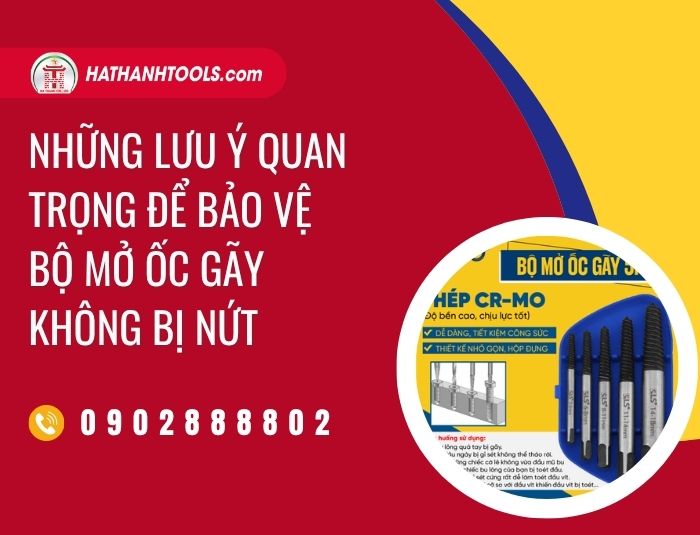
Important Notes to Protect Your Broken Screw Extractor from Breaking
Use Hand Power Only, Never a Power Drill
Many mechanics make the mistake of chucking the extractor into a cordless drill to speed things up. Power drills generate sudden and jarring torque. This force differential will immediately snap the extractor bit. The broken screw extractor usage guide always advises mechanics to use a hand wrench to turn slowly, allowing them to feel the resistance of the screw and adjust their force accordingly.
Don't Force It If the Screw Won't Budge
If you've applied considerable force and the broken screw remains stubbornly in place, stop. Do not try to leverage it further, as this will break the extractor. Loosen it, spray more RP7, or use a propane torch to heat the surrounding engine block to expand the metal, break the rusted bond, and then attempt extraction again.
Contact us now: 0902 8888 02
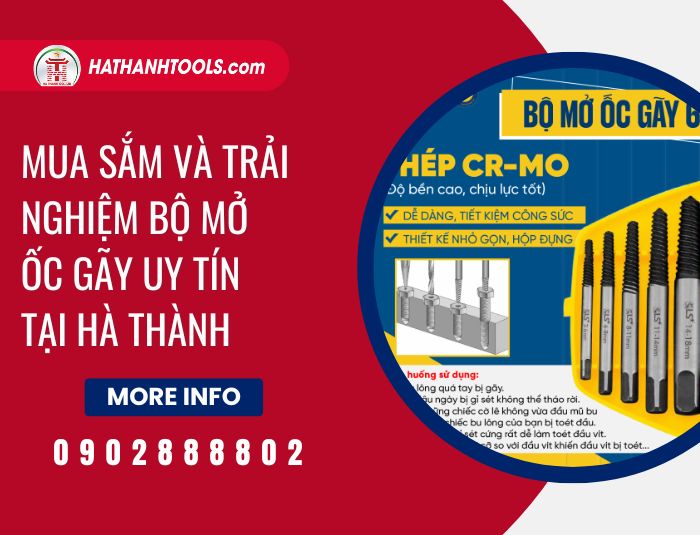
Purchase and Experience Reliable Broken Screw Extractors at Ha Thanh
No matter how skilled you are, if the tools are made from low-quality alloy steel, the failure rate remains high. To protect expensive engine blocks, investing in a professional broken screw extractor set is absolutely worthwhile.
Ha Thanh Trading & Service Co., Ltd. – Ho Chi Minh City Branch is a premier supplier of broken screw extractors made from high-speed steel (HSS) and ultra-hard S2 alloy. Our products feature superior sharpness in their flutes and high torsional strength, ensuring they won't snap or break during use.
Upon visiting our showroom, customers will receive detailed guidance from Ha Thanh's technical team on pilot drilling and actual extraction techniques. Equip yourself with an imported broken screw extractor set from Ha Thanh Trading & Service Co., Ltd. – Ho Chi Minh City Branch, and seized bolts will no longer be a nightmare in your workshop!
Contact us now: 0902 8888 02
10 Frequently Asked Questions About Multi-Purpose Broken Screw Extractors
1. Does the broken screw extractor usage guide apply to stripped screw heads?
Answer: Yes. If a Phillips head screw is stripped and cannot be turned, you can apply the same procedure: drill a small pilot hole in the center of the screw head and then insert a reverse thread extractor to remove it.
2. Is the pilot hole drilling step mandatory?
Answer: 100% mandatory. Without a pilot hole, the extractor will not have a place to embed deeply and grip the broken screw's shaft with its spiral flutes.
3. How deep should I drill the pilot hole?
Answer: You should drill to a depth of about 5mm to 10mm (depending on the length of the broken screw piece). This depth is sufficient for the extractor to grip firmly and create friction without drilling through the screw.
4. Why do broken screw extractors have reverse threads?
Answer: Because screws are tightened into the engine block clockwise (right-hand thread). When you use a reverse thread extractor and turn it counter-clockwise, it will grip the screw more tightly while simultaneously pushing the screw outwards.
5. Between HSS and Cr-V steel, which makes a better screw extractor?
Answer: High-speed steel (HSS) or S2 alloy is significantly better. They offer superior hardness (HRC rating), better friction resistance, and more effective resistance to breaking or bending compared to Cr-V.
6. Can I use an impact wrench to drive the extractor for speed?
Answer: Absolutely not. The hammering action of an impact wrench will instantly shatter a hard steel extractor bit. Only use a wrench or a T-handle to turn by hand power.
7. What is the function of spraying RP7 during the extraction process?
Answer: RP7 helps penetrate and break down the rust particles binding the screw threads to the internal threads, significantly reducing the turning force required and protecting the extractor from overload.
8. What happens if the pilot hole is drilled off-center into the engine block's threads?
Answer: It's very damaging. This will ruin the engine block's original threads. Therefore, the step of using a center punch to mark the center before drilling is extremely important.
9. Does Ha Thanh Company sell individual extractors if I lose one?
Answer: Ha Thanh Trading & Service Co., Ltd. – Ho Chi Minh City Branch primarily distributes sets (5-6 bits) to ensure uniformity and a complete range of sizes for mechanics.
10. Where can I buy genuine, affordable multi-purpose broken screw extractor sets?
Answer: Visit the showroom of Ha Thanh Trading & Service Co., Ltd. – Ho Chi Minh City Branch to purchase ultra-hard extractor sets that guarantee extraction, with a manufacturer's one-to-one replacement warranty for defects.
Contact Information
-
Ha Thanh Trading & Service Co., Ltd. – Ho Chi Minh City Branch
-
Hotline: 0902 8888 02
-
Address: 35 Nguyen An Khuong, Cho Lon Ward, Ho Chi Minh City
-
Email: cskh@hathanhls.com
-
Tax Code: 0100108529-006
-
Website: https://hathanhtools.com