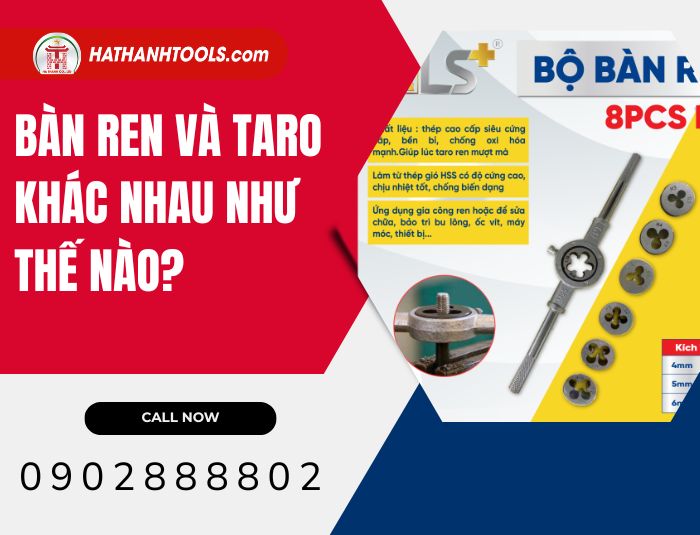
How do Die Nuts and Taps Differ? Exploring the Pair of Metal Cutting Tools
In mechanical engineering, milling, or machinery maintenance and repair, threading metal parts is an unavoidable process. When it comes to creating threads, mechanics must always be equipped with a pair of extremely sharp cutting tools. However, for those new to mechanics, the question "How do die nuts and taps differ?" often causes confusion. Both tools share the common goal of creating closed helical threads, but their application positions and metal cutting principles are completely opposite.
To distinguish them in the easiest way, simply remember a basic physical rule about cutting positions: external threads and internal threads. If you need to create threads on the surface of a metal shaft, a genuine die nut will be your powerful assistant. Conversely, if you need to create threads inside a drilled hole, a tap will undertake this crucial task.
With many years of experience in supplying industrial equipment and materials, Ha Thanh Co., Ltd. HCMC Branch will break down the detailed structure, operating methods, and core differences between these two tools, helping you equip yourself accurately and work more effectively.
Contact us now: 0902 8888 02
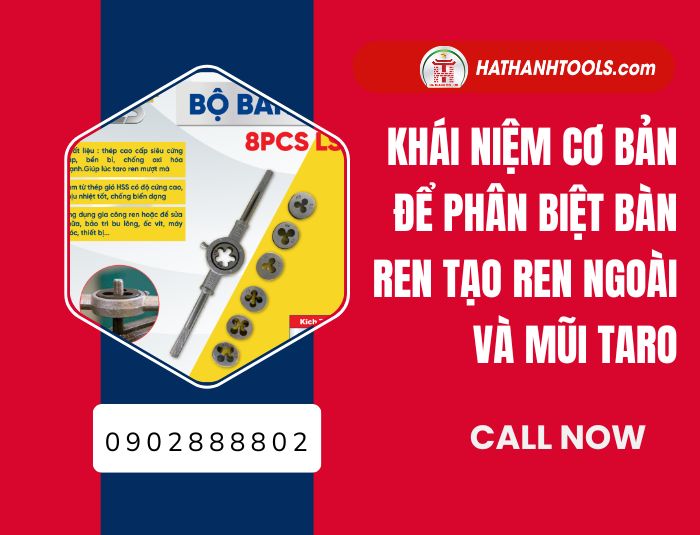
Basic Concepts to Differentiate Die Nuts for External Threads and Taps
What is a Metal Threading Die Nut?
A die nut (or Die) has a shape resembling a thick, round or hexagonal nut, but its difference lies in the internal flutes for chip removal and extremely sharp cutting edges facing inward.
-
The sole function of a die nut is to create external threads on the surface of a cylindrical metal shaft.
-
The result of using a die nut is that you will create a bolt or a threaded rod for screwing on nuts.
-
It is also widely used to repair and restore damaged or scratched external threads caused by impact.
What is a Tap?
A tap is shaped like a long, hardened steel bolt, with deep flutes along its body forming sharp cutting edges.
-
Contrary to a die nut, a tap is specialized for creating internal threads within a pre-drilled hole.
-
The result of using a tap is that you will create the threaded portion for a nut, or create a threaded hole in an engine block, aluminum frame, to insert a screw.
Contact us now: 0902 8888 02
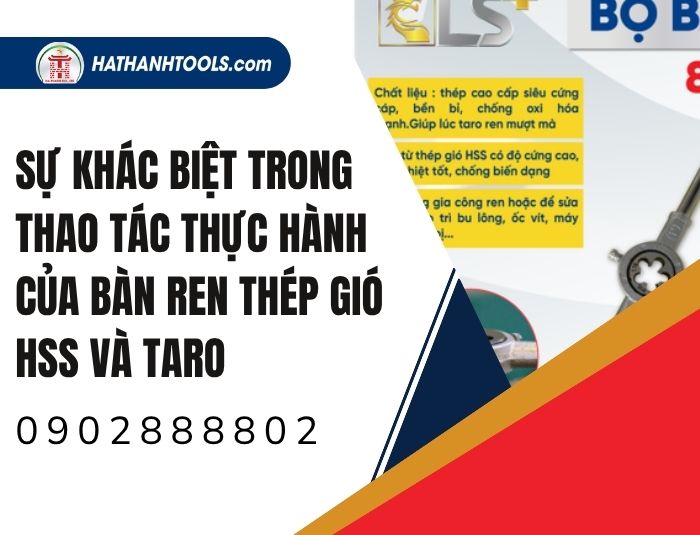
Differences in Practical Operation of HSS Die Nuts and Taps
Differences in Supporting Hand Tool Handles
To operate these two types of cutting tools, you cannot simply use your hands; you need specially designed handles (levers):
-
For Taps: You will use a "Tap Wrench." This tool has a square collet in the center to clamp the square shank of the tap, transferring torque from the two handles.
-
For Die Nuts: You must use a "Die Stock." This device has a circular cavity in the middle to fit the HSS die nut. Around the edge of the circular cavity are three to five set screws. You tighten these screws to press into the indentations on the die nut's rim, locking it firmly to prevent slippage during metal cutting.
Chip Breaking and Swarf Removal Process
Both tools apply the "turn half a turn forward, quarter turn back" principle to break chips. However, chip removal is easier for die nuts because they cut on the outer surface, with ample space for chips to fall. Conversely, taps cut grooves deep inside blind holes (non-through holes), where chips can easily get jammed. This requires the operator to frequently retract the tap to blow out debris.
Contact us now: 0902 8888 02
Practical Applications of Carbide Taps and Die Nuts
Handling Common Repair Situations
The most distinct differences are evident when it comes to field repairs:
-
When a stud or motorcycle wheel axle has its threads dented or deformed due to improper assembly, a mechanic will use a carbide die nut to run over it once. The die nut's cutting edges will shave off the excess metal, restoring the threads to their original condition.
-
In cases where an engine block's oil drain hole threads are stripped (worn out), a mechanic must use a drill bit to enlarge the hole slightly. Then, they will thread in a tap to create new, larger internal threads, and insert a larger bolt to seal the oil.
The Importance of Steel Material
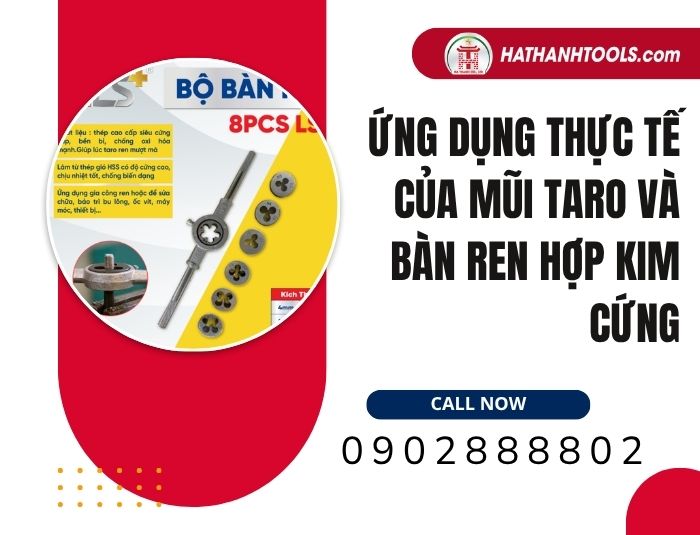
Whether it's a die nut or a tap, they must be made from excellent steel materials (like HSS or Tungsten steel) because they need to be strong enough to cut through other metal materials. The sharpness of the tool determines whether the thread groove's surface is smooth and precise.
Contact us now: 0902 8888 02
Purchase Wholesale Die Nuts and Accurate Taps at Ha Thanh
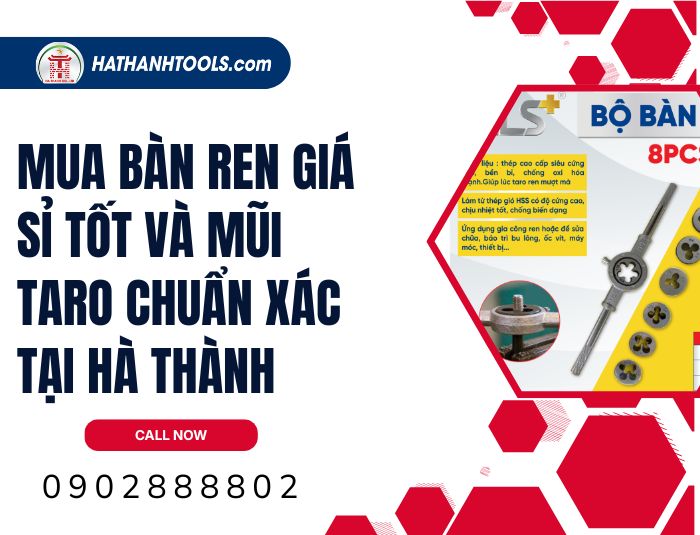
Once you clearly understand "How do die nuts and taps differ?", choosing technically compliant equipment is extremely important. Ha Thanh Co., Ltd. HCMC Branch is proud to be a leading distributor of metal cutting and machining tools.
At Ha Thanh, customers will receive in-depth consultation on metric (M), inch, and pipe thread standards, as well as access to the best wholesale die nuts for production workshops and maintenance garages. Ha Thanh tools are always guaranteed for high hardness, excellent wear resistance, and smooth tapping without the risk of breakage.
A machine part is truly perfect only when its threads mesh perfectly with each other. By equipping yourself with a high-quality set of die nuts and taps, you are securing the success of your mechanical projects. Contact Ha Thanh Co., Ltd. HCMC Branch immediately to acquire the most professional thread-making tool sets.
Contact us now: 0902 8888 02
10 Frequently Asked Questions about Premium Industrial Die Nuts and Taps
1. What is the shortest way to describe the difference between die nuts and taps?
Answer: Die nuts are used to make "external threads" (creating bolts, threaded shafts). Taps are used to make "internal threads" (creating nut threads, threaded holes for screws).
2. Can a die nut create internal threads in a hole?
Answer: Absolutely not. The design of a die nut with inward-facing cutting edges only allows it to cut metal on external cylindrical shafts.
3. Can I use the same handle for both die nuts and taps?
Answer: No. A tap wrench has a square collet. A die stock has a round cavity secured by screws. You must have two separate types of handles.
4. Why are there V-shaped notches around the rim of a die nut?
Answer: These V-shaped notches are for the screw heads on the die stock to engage and lock firmly, preventing the die nut from rotating freely under cutting force.
5. Is lubrication necessary when using a die nut?
Answer: Very necessary. Even when using the most premium industrial die nut, a lack of oil or coolant will burn the cutting edges and cause swarf to scratch the thread.
6. Why does a set of hand taps usually have 3 taps?
Answer: To divide the cutting force, it's split into 3 taps: a taper tap (long chamfer for initial cutting), a plug tap (deeper cutting), and a bottoming tap (short chamfer for final precise threading).
7. The threads on my bolt are stripped, can I fix it with a die nut?
Answer: If the bolt threads are just dented or rusted, a die nut can effectively reshape them. However, if the threads are completely worn away, they cannot be repaired.
8. Which is better for threading, HSS or Carbon Steel?
Answer: HSS (High-Speed Steel) is far superior. It can withstand high temperatures and friction and does not wear out as quickly as carbon steel.
9. Can metric (M) and inch die nuts be used with the same bolts?
Answer: Absolutely not. The thread pitch and crest angle of these two systems are completely different. Forcing them together will immediately burn the thread root.
10. Where should I buy genuine and reputable die nut and tap sets?
Answer: Visit Ha Thanh Co., Ltd. HCMC Branch to equip yourself with a complete set of metal cutting tools, guaranteed for origin and durability that withstands time.
Contact Information
-
Ha Thanh Co., Ltd. HCMC Branch
-
Hotline: 0902 8888 02
-
Address: 35 Nguyen An Khuong, Cho Lon Ward, Ho Chi Minh City
-
Email: cskh@hathanhls.com
-
Tax Code: 0100108529-006
-
Website: https://hathanhtools.com