Differentiating Concrete Chisel Bits – A Detailed Guide
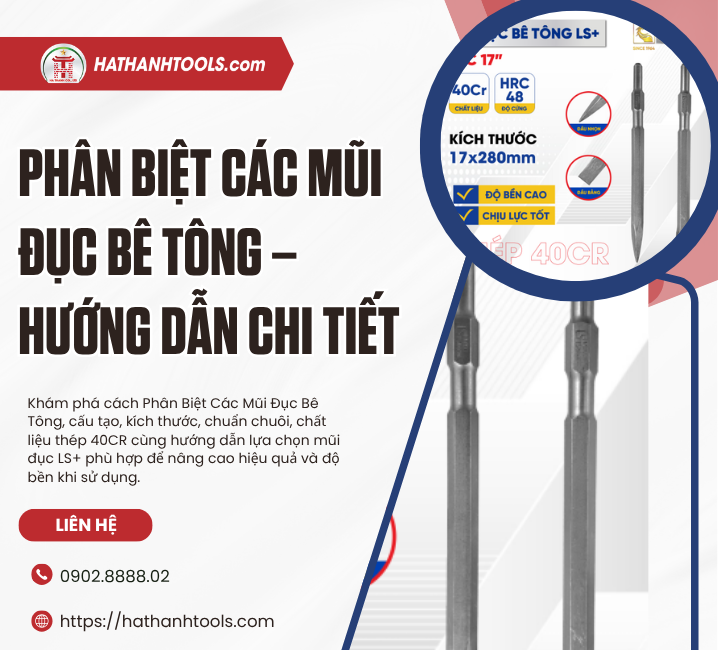
In the fields of construction, building renovation, and electrical/mechanical installation, differentiating concrete chisel bits is crucial knowledge that helps users select the right tools, improve working performance, and extend the lifespan of both machines and accessories. In reality, many people only pay attention to the length of the chisel bit while ignoring factors such as shank type, chisel head shape, material, or compatibility with each machine line. This easily leads to installing the wrong shank standard, reducing impact force, damaging the machine's chuck, or reducing construction efficiency.
Currently, concrete chisel bits on the market are highly diverse, ranging from pointed-nose concrete chisels, flat-nose concrete chisels, 17 mm hex shank chisels, 14 mm round shank chisels, and 18 mm round shank chisels to heavy-duty concrete breaker bits. Each type is designed to serve a specific purpose such as breaking concrete, stripping tiles, prying mortar layers, or cleaning material surfaces.
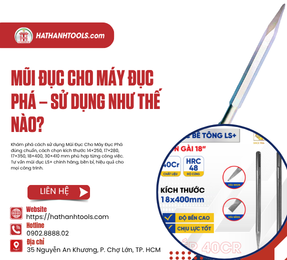
According to information from Hathanhtools.com, the 40Cr LS+ concrete chisel bit series is manufactured from high-grade 40Cr alloy steel, with many models reaching a hardness of HRC 48, providing excellent load-bearing capacity, wear resistance, and meeting high-intensity work demands. The product line is developed in various concrete chisel bit sizes and popular shank standards, making it easy for users to choose according to each type of machine and construction task.
The article below will help you differentiate concrete chisel bits in detail through their construction, tip shapes, shank types, practical applications, as well as guides on how to choose chisel bits according to the machine for optimal work efficiency.
What is the Structure of a Concrete Chisel Bit?
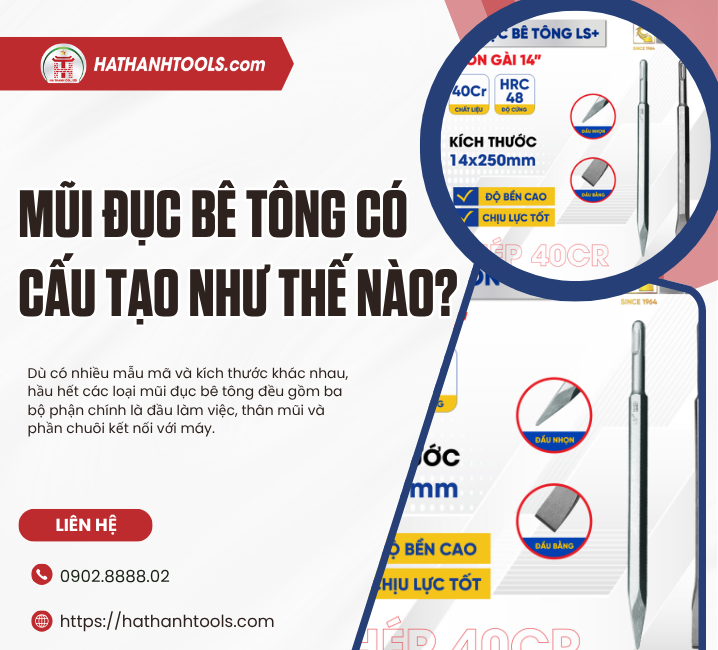
To clearly understand how to differentiate concrete chisel bits, you first need to grasp their basic structure. Despite having various designs and sizes, most concrete chisel bits consist of three main parts: the working tip, the body, and the shank connecting to the machine. Each part performs a specific function, directly affecting demolition efficiency, durability, and compatibility with construction equipment.
The Working Tip of the Chisel Bit
The working tip is the part in direct contact with concrete or demolition materials. It is also the factor that decides the utility of each type of concrete chisel bit.
For pointed-nose concrete chisels, the pointed design concentrates the entire impact force onto a small point. As a result, the impact energy is transmitted deep into the material, helping to break concrete faster, create initial fracture points, or penetrate hard structural areas. This tip type is particularly suitable when breaking rocks, thick concrete, or creating starting grooves before expanding the work area.
Meanwhile, flat-nose concrete chisels have a wider blade, distributing the impact force over a larger area. This design is suitable for stripping tiles, prying mortar, cleaning surfaces, or breaking thin concrete layers. The flat tip also helps create wider grooves compared to the pointed tip, thereby improving efficiency when handling surfaces after the main structure has been broken.
Choosing the right tip shape will help improve work performance, reduce tool wear, and minimize incorrect tool usage.
The Chisel Body and Load-Bearing Capacity
Following the working tip, the body is the part that absorbs and transmits all impact forces from the machine to the material. Therefore, the material used to manufacture the chisel body plays an essential role in the product's durability and lifespan.
According to information on the 40Cr LS+ concrete chisel series, the body is crafted from high-grade 40Cr alloy steel. This steel type offers high load-bearing capacity, resists deformation, and maintains stability during high-intensity work. Some lines also reach a hardness of HRC 48, which increases wear resistance and extends usage time even when frequently working on concrete or hard materials.
Thanks to this material, concrete chisel sizes from small types to those specialized for breaker machines can work stably, reducing body bending or fracturing when used with the correct capacity and machine type.
The Shank Connecting to the Machine
The shank is the part that directly connects the chisel bit to the rotary hammer or demolition hammer. This is a particularly important factor when differentiating concrete chisel bits, as not every chisel bit can fit into every machine.
Currently, 17 mm hex shank chisels, 14 mm round shank chisels, 18 mm round shank chisels, and concrete breaker bits all use different shank standards. Users need to accurately check the machine's chuck standard before choosing a product, instead of only focusing on the chisel bit's length.
For example, a 17 mm hex chisel is only compatible with machines using a 17 mm hex shank standard.
Similarly, the 14 mm round shank chisel and 18 mm round shank chisel are designed for machines with corresponding chuck standards. Installing the wrong shank standard not only reduces force transmission efficiency but can also damage the machine's chuck or cause safety hazards during construction.
Therefore, one of the most important principles in choosing chisel bits according to the machine is to always prioritize checking the shank standard before considering the length or tip shape. This will ensure stable equipment operation, efficient force transmission, and extend the lifespan of both the machine and its accessories.
Differentiating Chisel Bits by Tip Shape
When differentiating concrete chisel bits, the tip shape is the first factor to consider because it directly determines force transmission and purpose of use. Although all made from high-durability 40Cr steel, pointed-nose concrete chisels and flat-nose concrete chisels yield different results for each construction task. Choosing the right tip shape not only increases working speed but also limits tool wear and reduces the load on the hammer.
Pointed-Nose Chisel Bit
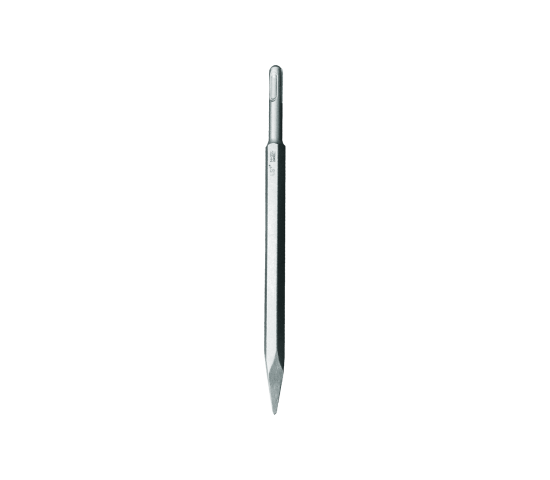
Pointed-nose concrete chisels are designed with a tapered tip to concentrate the entire impact force onto a single point. When the machine operates, the impact energy is transmitted directly to the point, generating high pressure that quickly causes cracks in concrete or hard materials. Thanks to this high concentration of force, this chisel type is commonly used for tasks requiring breaking thick concrete, chiseling rocks, or opening starter points before proceeding with wide-area demolition.
In building construction, pointed-nose concrete chisels are also used to create initial grooves when installing concealed plumbing and electrical systems or breaking down solid structural areas. For renovation projects, the pointed tip helps workers easily locate the area to be demolished without heavily impacting the surrounding areas. This is also the ideal choice when dealing with hard concrete layers or materials with high compressive strength.
Thanks to its efficient force concentration, the 40Cr LS+ pointed-nose concrete chisel is always selected by many contractors for jobs requiring high demolition speed and performance.
Flat-Nose Chisel Bit
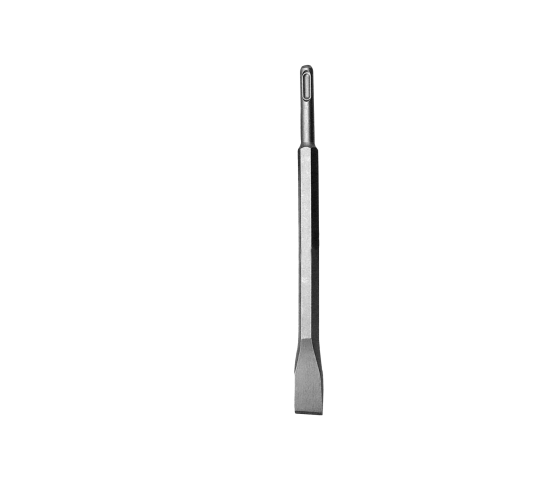
Unlike the pointed nose, flat-nose concrete chisels feature an expanded blade to distribute the impact force over a wider surface area. This design helps strip materials layer by layer instead of focusing deep into a single point.
In practice, flat-nose concrete chisels are commonly used to strip floor tiles, wall tiles, remove old mortar, or pry thin concrete layers after they have been preliminary broken. In addition, this tip type supports cleaning concrete surfaces before applying a new finish or creating wider grooves during building renovations.
For tasks requiring the chiseled surface to be relatively flat and neat, the flat nose will deliver higher efficiency than the pointed nose. At the same time, dispersing the force over a wide area helps prevent breaking too deep into unnecessary structures.
With a variety of lengths and concrete chisel bit sizes, users can choose a suitable flat nose for each scope of work, from residential repairs to professional construction projects.
When to Use the Pointed and Flat Duo?
When differentiating concrete chisel bits, many people often wonder whether to choose a pointed or flat nose. In fact, these two types do not replace but rather complement each other to create a more efficient construction process.
Typically, workers will use a pointed-nose concrete chisel in the initial phase to create break points, penetrate deep into the concrete, or open up initial crack lines. Once the material structure is broken, a flat-nose concrete chisel is used to expand the work area, strip the remaining material, and clean the surface.
The combination of both tip types reduces working time, limits tool wear, and optimizes hammer efficiency. This is also the method applied by many technicians in professional renovation, repair, and demolition projects.
Differentiating Chisel Bits by Shank Type
In addition to the tip shape, shank type is also an important criterion when differentiating concrete chisel bits. Each rotary hammer or demolition hammer is designed with its own chuck standard; thus, selecting the correct shank standard will ensure stable force transmission, safety, and extend the lifespan of both the machine and the chisel bit.
Currently, Hathanhtools.com provides many 40Cr concrete chisel bit series with popular shank standards such as 14 mm round shank chisels, 18 mm round shank chisels, 17 mm hex shank chisels, and concrete breaker bits for high-power machines. Each product is designed to suit specific equipment groups and different construction requirements.
14 mm Round Shank Chisel
The 14 mm LS+ round shank chisel is a suitable choice for rotary hammers and light-duty hammers using a 14 mm chuck standard. According to product specifications, this chisel model has a length of about 250 mm, crafted from 40Cr alloy steel with a hardness of HRC 48, offering excellent wear and impact resistance during use.
The product is available in both pointed and flat tip versions, meeting various needs such as breaking thin concrete, chiseling brick walls, stripping floor tiles, or handling residential repairs. Before purchasing, users need to check the machine's exact chuck standard to ensure the 14 mm round shank chisel fits perfectly and operates stably.
18 mm Round Shank Chisel
For tasks requiring greater impact force or deeper access to concrete structures, the 18 mm round shank chisel is the right choice. The LS+ series is manufactured from 40Cr steel with a hardness of HRC 48, increasing load-bearing capacity and durability under high-intensity working conditions.
Compared to the 14 mm standard, the 18 mm round shank chisel is longer, at approximately 400 mm, helping to expand the working range and increase efficiency when breaking thick concrete or hard structures. The product also offers pointed and flat tip options to meet various construction requirements.
When making a choice, users should prioritize choosing chisel bits according to the machine, ensuring the chisel shank is fully compatible with the equipment's chuck to avoid wobbling or reduced force transmission efficiency.
17 mm Hex Shank Chisel and Breaker Shank
For specialized demolition hammers or high-power concrete breakers, 17 mm hex shank chisels are commonly used. Hathanhtools.com currently provides 17 × 280 mm and 17 × 350 mm models, all made from premium 40Cr steel with outstanding load-bearing capacity and wear resistance.
Additionally, the 30 × 410 mm concrete breaker bit line is specifically designed for high-power equipment, supporting work on thick concrete structures or large-scale demolition projects. The product features both pointed and flat tips to meet each usage requirement.
An important note is to never mix shank standards. 17 mm hex chisels, 14 mm round shank chisels, 18 mm round shank chisels, and concrete breaker bits all have different connection designs. Using the wrong standard not only reduces construction efficiency but can also damage the machine's chuck, affecting safety during operation. Therefore, checking the shank standard is always the first and most crucial step when selecting concrete chisel bits.
How to Choose Concrete Chisel Bits According to the Job
After differentiating concrete chisel bits by tip shape and shank style, the next step is to choose the right product for each construction need. No single type of concrete chisel bit meets all job requirements. Each task requires its own tip type, dimensions, length, and shank standard to achieve optimal efficiency.
Selecting the correct concrete chisel bits not only increases work productivity but also limits machine wear, reduces the risk of bit breakage, and saves replacement costs over long-term use.
Choosing Bits for Concentrated Concrete Demolition
When breaking thick concrete, foundations, or hard structures, users should prioritize pointed-nose concrete chisels. The pointed design concentrates all impact force onto a single point, creating cracks quickly and assisting in deep demolition more effectively than flat-nose bits.
Besides the tip shape, chisel length must also be considered. For standard residential jobs, a length of about 250–350 mm is appropriate. For larger projects or deeper demolition, you can choose 17 mm hex chisels with a length of 350 mm or 30 × 410 mm concrete breaker bits to increase reach.
Particularly, users must choose the correct shank diameter according to the machine. This is a critical factor in how to choose chisel bits according to the machine, helping to transmit force stably and limit vibration during operation.
Choosing Bits to Strip Tiles, Mortar, and Coatings
For interior renovations, removing floor tiles, stripping old mortar, or removing thin concrete layers, flat-nose concrete chisels are the more suitable choice.
The flat nose can distribute force over a wide area, stripping materials layer by layer without causing excessive damage to the underlying structure. This is the chisel type favored by many finish carpenters and masons during residential, office, or civil renovations.
When making a choice, consider the area to be stripped to select the right tip size. For small areas, a standard flat tip allows for flexible handling. Meanwhile, larger surfaces can utilize wider flat tips to speed up construction and reduce working hours.
Manufactured from 40Cr concrete chisels with HRC 48 hardness, LS+ products maintain high impact resistance even when working continuously on various building materials.
Choosing Bits for High-Power Demolition Hammers
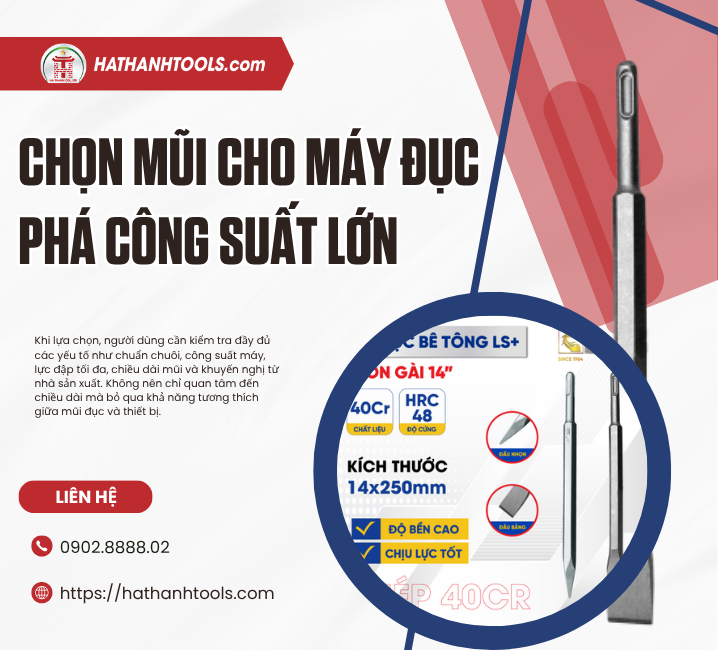
For large-scale construction projects or professional demolition projects, high-power hammers usually require specialized concrete breaker bits.
When choosing, users should verify all factors, including shank standards, machine power, maximum impact force, bit length, and manufacturer recommendations. Do not focus solely on length while neglecting the compatibility between the chisel bit and the device.
The 17 mm hex shank chisel lines and the LS+ concrete breaker chisel bits are all crafted from 40Cr alloy steel, suited for high-intensity working environments, delivering strong and stable force over long periods.
Choosing the right concrete chisel bit size according to each machine type will improve construction performance, reduce the load on the motor, and extend the lifespan of the entire equipment.
Using and Maintaining Concrete Chisel Bits
A quality concrete chisel bit will maximize its effectiveness if used correctly and maintained properly. Conversely, incorrect installation, overloading, or poor maintenance can cause the bit to wear out quickly, bend, crack, or suffer reduced working efficiency.
In addition to differentiating concrete chisel bits, users should also equip themselves with knowledge on how to inspect, operate, and maintain them to extend product lifespan.
Inspecting the Bit Before Operation
Before each shift, take a few minutes to inspect the condition of the 40Cr concrete chisel bit to ensure safety and construction efficiency.
Observe whether the chisel body is bent, and check if the tip is chipped or excessively dull. Simultaneously, check the shank for signs of wear, deformation, or cracks after long-term use.
Once installed in the machine, test run it without load for a few seconds to ensure the bit is held securely, with no abnormal vibration or unusual clattering sounds. If any abnormal signs are detected, replace it immediately to avoid affecting both the equipment and the operator.
Safe and Effective Chiseling Techniques
To maximize the efficiency of various concrete chisel bits, users must perform proper techniques throughout the construction process.
Always hold the machine with both hands to ensure good control over the chiseling direction and reduce vibration. Do not force your entire body weight onto the machine, as the device's impact force is already sufficient to break the material. Forcing the machine too hard only raises the temperature, reduces motor life, and causes the pointed or flat concrete chisel bits to wear out faster.
When breaking a large area, divide it into smaller sections to control the concrete's cracking direction and reduce pressure on the equipment. If the machine operates continuously for a long time, let it rest periodically to cool down the motor and the chisel bit.
In addition, operators must always equip safety goggles, gloves, safety shoes, and hearing protection to ensure safety in construction environments.
Maintenance Tips to Extend Lifespan
After each use, clean off concrete dust, mortar, and material fragments remaining on the concrete breaker bits, or on the 14 mm round shank, 18 mm round shank, and 17 mm hex shank chisel lines.
Next, wipe dry the entire body of the chisel to limit oxidation. For some machine models, users can apply a thin layer of grease/oil to the shank as recommended by the manufacturer to reduce friction when inserting into the tool holder.
Chisel bits should be stored separately according to each shank standard to avoid collisions that chip the tips or cause confusion during use. Do not store tools in damp environments or in direct contact with corrosive chemicals.
Proper maintenance not only helps maintain the durability of 40Cr concrete chisel bits but also ensures stable performance throughout long-term use.
Contact Us
Ha Thanh Company Limited - HCMC Branch is a unit specializing in trading and wholesaling hardware, hand tools, consumables, power tools, battery-powered tools, and various equipment for repair and construction. With a diverse product portfolio, stable quality, and professional support services, Hathanhtools.com is always ready to accompany customers in every project, from residential to industrial.
If you are looking for high-quality concrete chisel bits, pointed-nose concrete chisels, flat-nose concrete chisels, 17 mm hex shank chisels, 14 mm round shank chisels, 18 mm round shank chisels, or genuine LS+ concrete breaker bits, please visit hathanhtools.com to view product information, receive technical advice, and get nationwide delivery quotes.
Contact Information
Ha Thanh Company Limited - HCMC Branch
Hotline: 0902 8888 02
Address: 35 Nguyen An Khuong, Cho Lon Ward, Ho Chi Minh City
Email: cskh@hathanhtools.com
Website: https://hathanhtools.com
Tax Code: 0100108529-006