What Is an Eccentric Drill Bit? Unexpected Uses
In construction, mechanics, furniture installation, or residential repairs, the quality of a drill bit directly affects drilling accuracy, construction speed, and the lifespan of the equipment. Besides traditional drill bits, multi-purpose off-center 2-edge drill bits are increasingly favored by professional technicians and DIYers thanks to their ability to work on various materials, reduce vibration, and create cleaner holes.
However, when searching for the phrase "what is an eccentric drill bit", many people confuse an accidentally off-center drill bit due to technical errors with a drill bit intentionally designed with two off-center edges. These are two completely different concepts. One is an error occurring during use or installation that causes the drill bit to vibrate heavily, while the other is a technical design aimed at improving cutting efficiency and material handling capabilities.
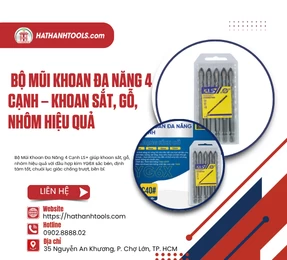
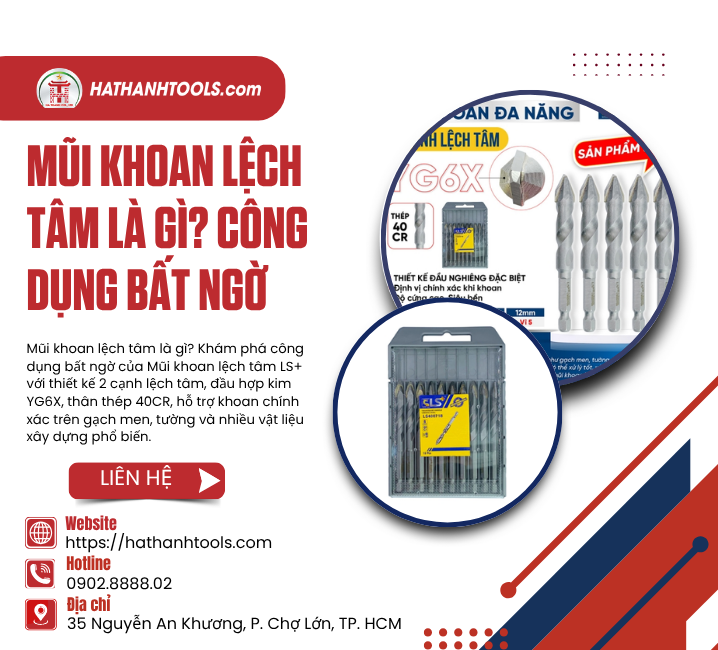
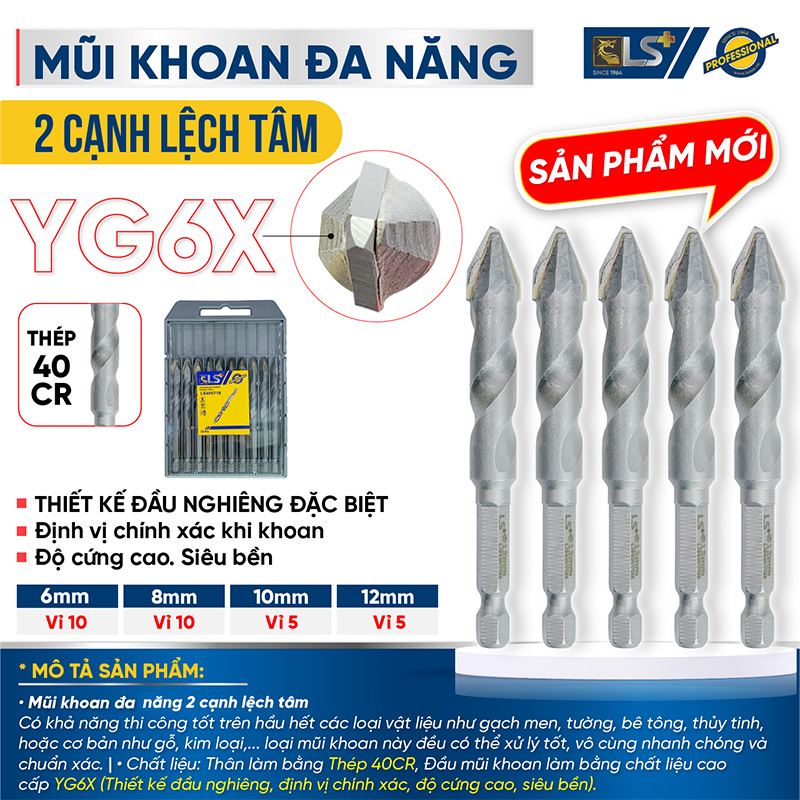
Among them, the LS+ Eccentric Drill Bit is a product line engineered with a 2-edge off-center design, utilizing a YG6X carbide tip and a 40CR steel shank, available in various sizes from 6 mm to 12 mm to meet diverse drilling needs on ceramic tiles, wood, plastic, sheet metal, and other common building materials.
Not only helping to improve working efficiency, the multi-purpose eccentric drill bit also helps reduce tool-changing time, optimize the construction process, and increase the accuracy of each drilled hole. Therefore, this product is being widely applied in construction, electrical, plumbing, interior design, and building renovation.
The article below will help you clearly understand what an eccentric drill bit is, how to distinguish between runout errors and eccentric design, the structure of the LS+ 2-edge eccentric drill bit, as well as the practical benefits this product brings.
What is an eccentric drill bit?
When first hearing the concept of what an eccentric drill bit is, many people often think of a bent, defective, or improperly centered drill bit. In reality, the term "eccentric" or "off-center" in the hand tool industry is used in two completely different contexts.
The first case is a drill bit having runout (off-center rotation) due to a defect, arising from a bent shank, an inaccurate drill chuck, or a worn-out bit after long-term use. This phenomenon reduces hole quality and affects safety during construction.
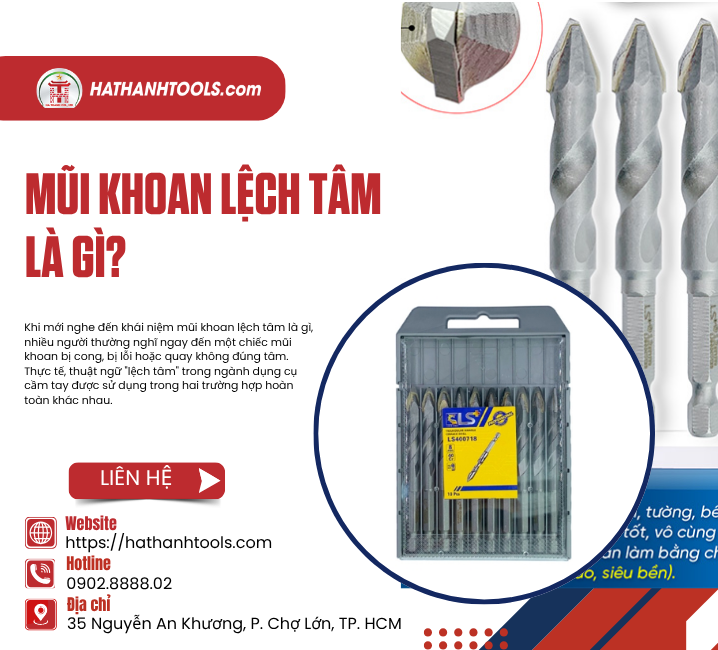
The second case is a drill bit intentionally designed with two eccentric edges, typically represented by the LS+ 2-Edge Eccentric Drill Bit. This is an engineered design researched to increase material contact, reduce vibration, improve cutting efficiency, and make it easier for users to control the drilling path.
According to product information from Hathanhtools.com, the LS+ Eccentric Drill Bit carries code LS70260, featuring a YG6X carbide head, a 40CR steel body, and sizes of 6 mm, 8 mm, 10 mm, and 12 mm, meeting a wide range of construction needs from DIY to professional use.
Understanding the concept of what an eccentric drill bit is correctly will help users select the right product, avoiding confusion between a modern engineering design and a technical defect that needs fixing.
The phenomenon of drill bit runout (accidental off-center)
One of the common errors when using a drill is runout due to non-concentric spindle rotation. This is a condition where the drill tip does not rotate along the true center axis but oscillates from side to side during operation.
When this phenomenon occurs, users can easily notice signs such as:
-
The drill bit vibrates strongly even before contacting the material.
-
The drilled hole is wider than the actual diameter of the bit.
-
The drilling path deviates from the marked position.
-
The hole walls are uneven.
-
The drill vibrates excessively and is difficult to control.
-
The machine noise is louder than normal.
-
The bit tip heats up quickly and wears down fast.
The causes of this phenomenon can stem from:
-
The drill bit shank is bent after an impact.
-
The drill chuck is worn out or not tightened properly.
-
Poor-quality drill bit.
-
The drill bit is deformed after a period of use.
-
Problems with the drill spindle/shaft.
If you continue to use a vibrating drill bit, not only will the quality of the hole be affected, but it will also shorten the machine's lifespan and increase safety risks during work.
This phenomenon is completely different from the multi-purpose eccentric drill bit, which is intentionally designed by the manufacturer.
Intentionally Designed Two-Edge Eccentricity
Unlike runout errors, the 2-Edge Eccentric Drill Bit is researched and manufactured with a special cutting tip geometry to enhance working efficiency.
In the LS+ Eccentric Drill Bit line, the two cutting edges are arranged according to an engineered design to increase contact with the material surface during drilling. This is not a manufacturing defect but a solution to improve machining performance on various materials.
This design brings many benefits such as:
-
Reducing vibration while drilling.
-
Improving centering and positioning capabilities.
-
Supporting the creation of cleaner, nicer holes.
-
Increasing control over the drilling direction.
-
Reducing tip slippage on slippery surfaces.
-
Suitable for various construction materials.
As a result, the multi-purpose eccentric drill bit can be used on:
-
Softwood.
-
Hardwood.
-
Plastic.
-
Sheet metal.
-
Brick.
-
Ceramic tile.
-
Lightweight concrete.
-
Some other common construction materials.
This is also why many contractors choose the LS+ Eccentric Drill Bit to replace various specialized drill bits, helping optimize investment costs and improve productivity.
How to Distinguish Between Runout Errors and Eccentric Design
To avoid confusion between a drill bit with runout issues and an intentionally designed two-edge eccentric drill bit, users can perform a few simple checks below.
Observe vibration during no-load operation
Insert the drill bit into the chuck and run the machine at low speed without contacting any material.
If the drill bit rotates stably with virtually no abnormal vibration, this is a normal sign of a standard-compliant LS+ Eccentric Drill Bit.
Conversely, if the tip wobbles heavily in a circle or vibrates constantly, it is highly likely that either the bit shank or the drill chuck has an issue.
Check the straightness of the shank
Place the drill bit shank on a flat surface or roll it gently to observe.
A standard-compliant 40CR steel shank drill bit will be perfectly straight, not bent, twisted, or deformed.
If you find that the shank is visibly bent or misaligned, you should replace it to avoid affecting construction quality.
Observe the shape of the two cutting edges
For the 2-Edge Eccentric Drill Bit, the two cutting edges are engineered with a specific geometry unique to the manufacturer.
This is a product feature, not a sign of a technical defect.
Users should not confuse the eccentric cutting tip design with drill bit runout caused by a bent shank or rotation errors.
Check the drill chuck
In many cases, users assume the drill bit is defective when the actual cause stems from the drill chuck.
If the chuck is worn, not tightened properly, or has runout, the drill bit will vibrate even if the product itself is perfectly fine.
Therefore, before concluding that the drill bit is defective, check the following simultaneously:
-
The drill chuck.
-
The spindle/shaft.
-
The tightness of the chuck.
-
The condition of the bit shank.
-
The shape of the cutting tip.
Distinguishing accurately will help users utilize YG6X carbide bits, 40CR steel shank bits, and LS+ Eccentric Drill Bits for their correct purposes, while avoiding unnecessary replacements.
Structure of the Multi-Purpose Two-Edge Eccentric Drill Bit
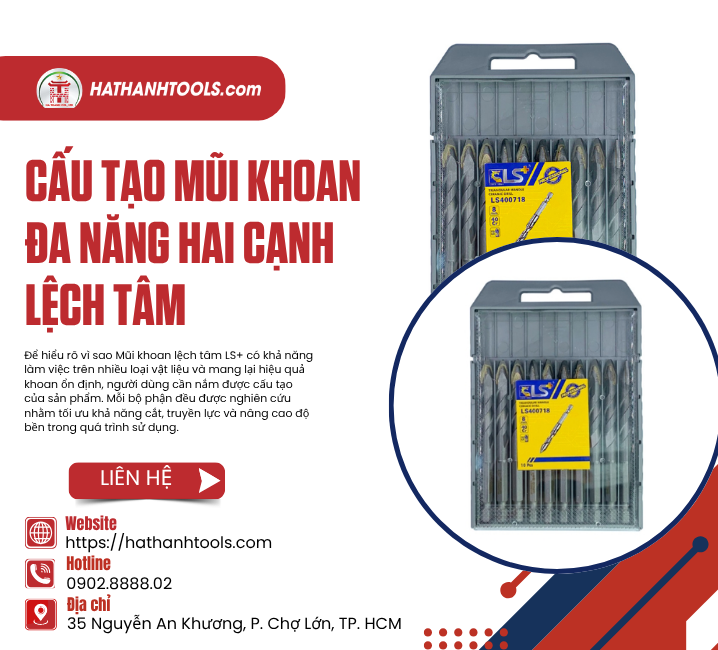
To clearly understand why the LS+ Eccentric Drill Bit is capable of working on many materials and delivers consistent drilling performance, users need to understand its structure. Each component is researched to optimize cutting performance, power transmission, and overall durability during use.
According to product information at Hathanhtools.com, the LS+ multi-purpose 2-edge eccentric drill bit carries product code LS70260, utilizing a YG6X carbide head, 40CR steel shank, featuring a two-edge eccentric design, and is produced in sizes ranging from 6 mm to 12 mm to satisfy various construction requirements.
In addition to providing the ability to drill through various materials such as wood, brick, ceramic tiles, lightweight concrete, or sheet metal, the product design also minimizes vibration, improves positioning, and yields highly aesthetic drilled holes.
YG6X Carbide Tip
One of the highlights of the YG6X drill bit is the cutting head made of ultra-hard carbide alloy, improving efficiency when working on various materials of different hardness levels.
The YG6X head offers several outstanding advantages, such as:
-
Enhanced wear resistance.
-
Maintaining sharpness for a long time.
-
Supporting stable drilling on hard surfaces.
-
Reducing the risk of chipping the tip.
-
Minimizing heat generation during drilling.
-
Contributing to extending the product's lifespan.
When combined with the 2-edge off-center design, the YG6X head also increases contact area with the material, improving cutting action and supporting more efficient chip evacuation.
This is also the factor that helps the non-slip ceramic tile drill bit operate more stably on hard or slippery surfaces.
For tasks requiring high precision like furniture installation, M&E construction, or household repairs, the YG6X head contributes to neat, clean holes while minimizing position deviations.
40CR Steel Shank – YG6X Carbide Tip
While the cutting tip determines the ability to penetrate materials, the shank is responsible for transmitting force from the drill to the tip.
The 40CR steel shank is selected to ensure a perfect balance between hardness, strength, and stability during operation.
Advantages of the 40CR steel body include:
-
High mechanical strength.
-
Excellent torque resistance.
-
Resisting bending or warping during continuous work.
-
Reducing the risk of deformation under heavy loads.
-
Stable power transmission from the drill to the cutting head.
-
Helping to reduce vibration during drilling.
Thanks to the combination of the YG6X carbide tip and the 40CR steel shank, the LS+ Eccentric Drill Bit can meet the demands of various work environments, from home repairs to professional construction.
This is also one of the key factors helping the product maintain stable performance under high-intensity working conditions.
Common Sizes
To suit various construction needs, multi-purpose eccentric drill bits are manufactured in different sizes. According to the product specifications, the LS+ Eccentric Drill Bit line currently features:
-
6 mm drill bit
-
8 mm drill bit
-
10 mm drill bit
-
12 mm drill bit
Each size is suitable for specific types of jobs.
6 mm Drill Bit
This size is very commonly used in household repairs.
Suitable for:
-
Installing small hanging racks.
-
Installing electrical wiring.
-
Mounting decorative accessories.
-
Installing wire conduits.
-
Hanging pictures.
8 mm Drill Bit
A larger diameter increases the load capacity of anchors.
Commonly used for:
-
Installing wall shelves.
-
Mounting bathroom fixtures.
-
Interior fit-outs.
-
Installing cable trays.
-
Running surface-mounted electrical conduit.
10 mm Drill Bit
This is the ideal choice for tasks requiring higher load capacity.
For example:
-
Installing metal frames.
-
Heavy equipment brackets.
-
Mechanical and electrical (M&E) systems.
-
Civil construction projects.
12 mm Drill Bit
This is the largest size in this product line.
Commonly applied in:
-
Construction works.
-
Technical installations.
-
Structural assembly.
-
Work scopes requiring large diameter holes.
Selecting the correct size (6 mm, 8 mm, 10 mm, or 12 mm) will help improve construction efficiency and reduce wear on both the drill bit and the power tool.
Packaging Standards of the Drill Bit
In addition to product quality, the packaging standard is also a key factor of interest to distributors, hardware shops, and construction companies.
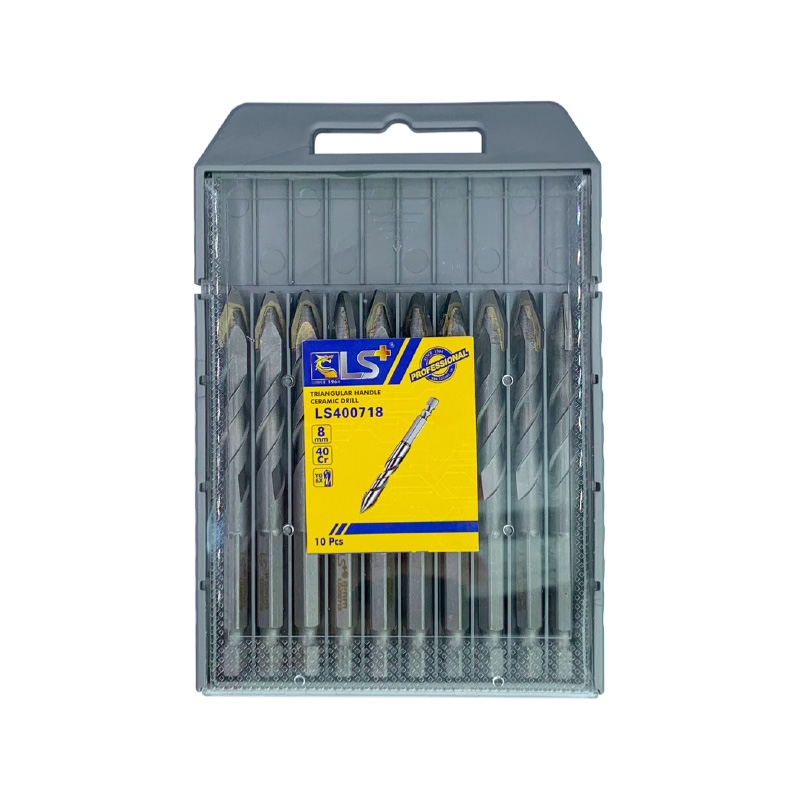
The LS+ Eccentric Drill Bit is carefully packaged to ensure quality during transport, warehousing, and distribution.
Standardized packaging helps:
-
Protecting the cutting tip.
-
Minimizing impacts.
-
Making inventory counts easy.
-
Convenient handling for shops and distributors.
-
Preserving product quality before use.
For regular contractors, choosing products with uniform packaging also helps manage materials more effectively.
Uses of the Eccentric Drill Bit
Far from being just a basic drilling tool, the LS+ multi-purpose 2-edge eccentric drill bit is engineered to meet multiple drilling requirements on different types of materials. Thanks to its special cutting tip design and high-quality materials, the product offers stable drilling, minimized vibration, and enhanced precision for the user.
From household repairs to interior fit-outs, electrical and plumbing work, or general construction, the multi-purpose eccentric drill bit can deliver great performance when used with proper techniques.
Drilling Ceramic Tiles with Reduced Tip Slippage
Drilling into ceramic tiles is always a demanding task that requires extreme care because tile surfaces are usually slippery and hard.
If the drill tip lacks positioning capability or the user operates it with incorrect technique, the bit can easily slip out of the marked position, ruining the look of the tile or cracking it.
Thanks to the 2-edge eccentric design, the non-slip ceramic tile drill bit helps improve surface traction from the very first rotations.
To achieve high efficiency, users should:
-
Accurately mark the drilling spot.
-
Apply masking tape over the drilling spot to increase grip.
-
Keep the drill perpendicular to the surface.
-
Start the machine at low speed.
-
Avoid applying excessive pressure.
-
Increase speed only after the tip has bitten into the material.
Following the steps above will make the drill-without-deviation method much easier, while minimizing tile edge chipping.
Drilling Walls, Bricks, and Building Materials
An outstanding advantage of the LS+ Eccentric Drill Bit is its capability to work on a wide range of common materials.
Users can utilize this product to drill on:
-
Brick walls.
-
Masonry bricks.
-
Ceramic tiles.
-
Wood.
-
Plastic.
-
Sheet metal.
-
Lightweight concrete.
However, each type of material has a different hardness.
Therefore, users need to:
-
Select the correct drilling mode.
-
Check the machine's power capacity.
-
Adjust the speed accordingly.
-
Avoid applying too much downforce.
-
Check the sharpness of the cutting tip before starting.
Combining the multi-purpose eccentric drill bit with the appropriate machine mode will extend product lifespan and enhance hole quality.
Applications in Repair and Construction
Thanks to its multi-material drilling capability, the 2-edge eccentric drill bit is used in many different fields.
Some common tasks include:
-
Installing wall hangers and brackets.
-
Interior furniture assembly.
-
Running concealed and surface-mounted electrical wiring.
-
Installing bathroom accessories.
-
Mounting wall shelves.
-
Installing security camera systems.
-
Installing signage.
-
Installing cable trays and conduits.
-
Home repairs.
-
Civil facility maintenance.
-
M&E installation.
-
Installing technical equipment.
For professional contracting teams, using the LS+ Eccentric Drill Bit reduces tool changeover times, boosts construction efficiency, and handles multiple work scopes with just one multi-purpose drill bit series. This is also the optimal solution for contractors needing flexibility, cost savings, and assured quality and accuracy for every drilled hole.
How to Use the Eccentric Drill Bit Effectively
Despite boasting a modern design with a YG6X carbide tip, a 40CR steel body, and a 2-edge off-center structure, the practical performance of the LS+ Eccentric Drill Bit still relies heavily on correct usage techniques. Proper operation not only creates clean holes and limits vibration, but also extends the working life of the drill bit and power tools.
For construction tasks on ceramic tiles, brick walls, wood, plastic, or lightweight concrete, users should follow proper procedures from preparation and drill selection to actual drilling techniques to achieve the best results.
How to drill without slipping and chipping edges
One of the common issues when drilling on ceramic tiles or glossy surfaces is the bit slipping away from the marked spot. This not only causes hole deviation but also ruins the project's aesthetics.
To keep drilling centered and prevent material chipping, users should apply the following helpful practices.
Apply tape at the drilling spot if necessary
For ceramic tiles or glass, you can apply a layer of paper masking tape on the marked spot before drilling.
The tape increases friction between the drill tip and the material surface, helping the non-slip ceramic tile drill bit anchor itself easily during the first rotations.
Do not apply excessive force
Many believe that pushing hard will speed up the drilling. In reality, excessive downforce only increases tip temperature, reduces tool life, and can easily crack the material.
Let the 2-Edge Eccentric Drill Bit do the cutting work instead of forcing it with excessive physical pressure.
Increase speed gradually
At the start of drilling, keep the machine running at a low speed to help the cutting head firmly bite into the marked spot.
Once the drill bit has penetrated slightly into the material, you can gradually increase speed for a more stable and efficient drilling process.
Keep the drill spindle stable
The drill must be held perfectly perpendicular to the surface throughout the entire operation.
Keeping the drill correctly aligned will help:
-
Produce rounder, cleaner holes.
-
Reduce vibration.
-
Minimize chipping of the material's edges.
-
Extend the lifespan of the cutting head.
-
Ensure drilling spot accuracy.
This is also a vital technique that ensures centered drilling when using the multi-purpose eccentric drill bit.
Choosing the Right Power Drill
Alongside drill bit quality, the type of power tool used also directly impacts construction efficiency.
Each type of drill is suited for different groups of tasks.
Cordless Drill
Cordless drills offer several advantages:
-
High flexibility.
-
Portability.
-
No reliance on power outlets.
-
Suitable for home repairs.
-
Interior furniture assembly.
When paired with the LS+ Eccentric Drill Bit, cordless drills perform excellently on wood, plastic, brick, and many common materials.
Impact Driver
Impact drivers are suitable for quick assembly jobs or high-volume tasks.
However, before use, you must check the compatibility between the chuck and the drill bit shank to ensure stable power transfer.
Hammer Drill / Percussion Drill
For hard materials like brick walls or lightweight concrete, a percussion/hammer drill works much better.
Users should choose the drilling mode appropriate for each material rather than always relying on hammer mode.
Especially when drilling ceramic tiles, it is recommended to use standard rotary mode at first, switching modes only after the tip has penetrated the glazed surface if needed.
Check the Chuck Before Inserting the Drill Bit
The chuck directly affects drilling accuracy.
Before each use, you should check:
Whether the chuck is worn out.
The tight clamping capability of the chuck.
The concentricity of the chuck.
Whether there is dust or foreign debris inside.
Regular checks help prevent drill runout caused by power tool faults rather than product defects.
When do you need to replace the drill bit?
Regardless of product quality, all tools have a certain lifespan. After extended use, the LS+ Eccentric Drill Bit should be inspected and replaced if signs of wear appear.
Dull cutting head
If drilling takes longer than usual or requires heavy force to penetrate materials, the YG6X drill bit head is likely worn.
At this point, replace it to ensure construction quality.
Bent bit body
A standard-compliant 40CR steel body drill bit will always maintain its straightness.
If the shank is bent due to impacts or improper use, vibration will increase and drilling accuracy will degrade.
Abnormal overheating during drilling
Under normal working conditions, the bit tip generates heat but stays within acceptable limits.
If the bit heats up too quickly even during short drilling durations, users should check:
-
The sharpness of the cutting head.
-
The drilling mode.
-
The rotational speed.
-
The quality of the material.
Strong vibration during work
If you have checked the drill chuck but bit runout/vibration still persists, the product is likely deformed or damaged.
Continuing to use it under these conditions can degrade drilling accuracy and compromise occupational safety.
Inaccurate drilled holes
When the drilled hole diameter is abnormally large, the edges are jagged, or the drilling spot is consistently misaligned, this is a clear sign that the drill bit needs replacement.
Using a fresh drill bit will ensure construction efficiency and limit damage to the workpiece.
HA THANH MTV CO., LTD - HCMC BRANCH is a business specializing in trading and wholesaling hardware, hand tools, consumables, electric tools, cordless tools, and other equipment for maintenance and construction. With a diverse product catalog and an experienced consulting team, Hathanhtools.com is always ready to accompany clients in selecting appropriate solutions for every requirement.
Visit hathanhtools.com to explore more product information, receive specifications consultation, and request nationwide delivery quotes.
Contact Information
Ha Thanh MTV Company Limited – HCMC Branch
Hotline: 0902 8888 02
Address: 35 Nguyen An Khuong, Cho Lon Ward, Ho Chi Minh City
Email: cskh@hathanhls.com
Website: https://hathanhtools.com
Tax code: 0100108529-006