How to Use HSS and TCT Carbide Hole Saws?
When there is a need to create large-diameter round holes on iron, stainless steel, steel, or other materials, HSS hole saws and carbide hole saws are two highly popular lines of tools. Although they serve the same purpose of hole cutting, each type has a different structure, cutting tooth material, and range of applications.
Many people looking for iron hole saws, stainless steel hole saws, or metal hole cutters often ask: what is the difference between HSS and TCT hole saws? How do you use an iron hole saw? When should you choose an HSS hole saw and when should you use a TCT carbide hole saw?
Choosing the right type of hole saw not only helps create fast, clean holes but also contributes to minimizing vibration, reducing wear, and improving the working efficiency of the drill. Especially for those who frequently work with metal, understanding the characteristics of each hole saw is essential to avoid using the wrong material or incorrect technique.
According to product information from Hathanhtools.com, LS+ HSS hole saws use HSS material and are available in various sizes to serve metal cutting needs, while LS+ carbide hole saws use TCT, aiming at the ability to handle suitable hard materials. In addition, Hathanhtools.com also provides LS+ wood and drywall hole saw sets for cutting needs on construction and interior materials.
So, what is the difference between HSS hole saws and carbide hole saws, and how should they be used to achieve the best results? Let's find out in detail.
What Is the Difference Between HSS Hole Saws and Carbide Hole Saws?
When looking for stainless steel hole saws or iron hole saws, many people often hesitate between HSS and TCT. The key difference lies not only in the price but also in the cutting tooth design, the material to be machined, and the operating conditions.
According to product information from Hathanhtools.com, LS+ HSS hole saws use HSS and are available in various sizes from 16 mm to 60 mm, while LS+ carbide hole saws use TCT, designed with carbide teeth to serve the cutting needs of suitable materials.
In essence, HSS and TCT represent two different design directions. HSS focuses on fast, flexible cutting on various suitable materials. Meanwhile, TCT utilizes cutting teeth made of tungsten carbide, which has excellent wear resistance and is more suitable for applications requiring the processing of hard materials.
What is an HSS Hole Saw?
HSS stands for High-Speed Steel. This is a material widely used in cutting tools due to its ability to maintain good hardness when operating at higher speeds compared to many conventional steels.
HSS hole saws are designed with annular cutting edges, which help create larger-diameter holes compared to using standard twist drill bits.
According to LS+ product information, the HSS hole saw line is used for materials such as thin iron, thin stainless steel, aluminum, wood, and plastic within suitable ranges. The product comes in various sizes to meet different hole diameter requirements.
A notable advantage of HSS hole saws is their flexibility. With the right size selection and correct drilling techniques, users can create holes relatively quickly on materials that the product is designed to process.
Regarding how to use an iron hole saw, it is crucial to determine the material thickness, desired hole diameter, drill type, and machining conditions before starting.
What is a TCT Carbide Hole Saw?
TCT stands for Tungsten Carbide Tipped, meaning the cutting teeth are tipped with hard tungsten carbide material.
Compared to HSS, TCT construction focuses on the hardness and wear resistance of the teeth. This is why TCT hole saws are often chosen when there is a need to process hard material groups suitable for the product's design.
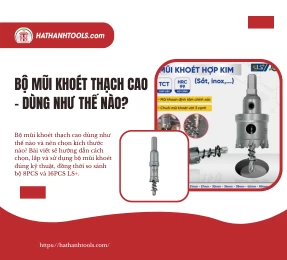
According to information from Hathanhtools.com, LS+ carbide hole saws are equipped with hard alloy teeth, which have excellent heat resistance and serve the cutting needs on iron, steel, stainless steel, aluminum, and some suitable hard materials.
A notable feature of this product line is the pilot drill bit design, which helps locate the cutting position before the cutting teeth begin to work. The 3-flat shank also helps increase the secure grip when inserted into a compatible drill.
When using carbide hole saws, users still need to operate with the correct technique. The hardness of TCT teeth does not mean the saw can withstand all types of impacts or heavy pressure. Allowing the saw to tilt, jam, or bite materials unevenly can affect the lifespan of the cutting teeth.
Comparison of HSS and TCT Hole Saws
To easily visualize how HSS and TCT hole saws differ, you can refer to the table below:
|
Criteria |
HSS Hole Saw |
TCT Carbide Hole Saw |
|
Structure |
HSS (High-Speed Steel) |
TCT Carbide Teeth |
|
Materials |
Suitable iron, stainless steel |
Suitable metal, hard materials |
|
Usage type |
General mechanical cutting |
Jobs requiring hard cutting teeth |
|
Notes |
Avoid overheating |
Avoid impact/chipped teeth |
Thus, there is no absolute answer to which is better, HSS or carbide hole saws. The better type is the one that is more suitable for the material, thickness, hole diameter, drill machine, and frequency of use.
How to Use HSS Hole Saws with Correct Technique
HSS hole saws are capable of creating round holes in metal and some other suitable materials. However, processing efficiency depends heavily on drilling speed, concentricity, workpiece stability, and heat control.
This is also an important section for those learning how to use HSS hole saws or how to operate an iron hole saw.
If too much force is applied, if the saw is misaligned, or if it is operated under unsuitable conditions, the cutting teeth can quickly wear out. Conversely, correct operation helps the saw work stably and create cleaner holes.
Choose the Right Hole Saw Diameter
-
The selection of the iron hole saw size should be based on the diameter of the hole to be created.
-
According to the product information of LS+ HSS hole saws, the available sizes include:
-
16, 18, 20, 21, 27, 30, 34, 35, 42, 50, and 60 mm.
-
Before cutting, accurately determine the diameter of the hole to be made. Do not choose a smaller size and then try to expand it by forcing the saw or shaking the drill, as this can reduce the stability of the cutting process.
-
For tasks like routing wires, making holes for accessories, or processing metal sheets, choosing the correct size from the start will help reduce finishing time.
-
If you are looking for a metal hole saw for your drill, you also need to check the compatibility between the shank of the saw and the drill chuck.
Centering and Securing the Material Before Cutting
-
Before applying the HSS hole saw to the material, accurately mark the position of the hole to be created.
-
The workpiece must be securely fixed. For metal sheets, clamping the workpiece helps minimize vibration or displacement during the drilling process.
-
After installing the saw into the machine, check its concentricity by running the machine at low speed if conditions permit. If the saw wobbles, stop the machine and inspect the chuck, shank, or installation method.
-
Concentricity directly affects hole quality. A stable running saw ensures more even cuts and reduces vibration.
Cut with Even Pressure and Control Heat
-
One of the key principles when learning how to use an HSS hole saw is not to force it down too hard.
-
Let the cutting teeth do the work at a suitable speed. Too much pressure can increase friction, leading to rapid heat build-up and affecting the lifespan of the saw.
-
When cutting metal, especially materials that generate high heat during cutting, you can use a coolant suitable for the machining conditions.
-
Users should also pay attention to the machine's speed. Increasing the speed doesn't always mean faster cutting. The speed must be appropriate for the saw diameter, material, and thickness of the workpiece.
Remove the Core After the Saw Has Completely Stopped
-
After completing the hole, allow the machine to come to a complete stop before handling the workpiece or the saw.
-
Do not put your hands near the rotating saw. Metal chips after cutting can be very sharp and cause scratches or cuts.
-
If the material core is stuck inside the saw, use a suitable method to extract it after the machine has stopped.
-
This is a seemingly simple but crucial step in how to safely use an iron hole saw.
How to Use TCT Carbide Hole Saws Effectively
Compared to HSS, TCT carbide hole saws have teeth made of hard alloy materials. While this provides excellent wear resistance, it also requires users to pay closer attention to issues like impact, jamming, or uneven material biting.
Understanding how to properly use carbide hole saws will help leverage the advantages of TCT and reduce instances of damaged cutting teeth.
Install the Hole Saw Securely and Check Concentricity
According to LS+ product information, carbide hole saws feature a pilot drill bit and a 3-flat shank.
The pilot drill bit helps locate the cutting position before the teeth make contact with the material. The 3-flat shank helps keep the saw stable in a compatible chuck.
Before starting work, check whether the saw is securely installed. If the saw is loose or misaligned, do not continue to operate.
Good concentricity helps reduce vibration and prevents cutting teeth from making uneven contact with the material surface.
Feed the Saw into the Material Gradually
When starting to cut, let the pilot bit make contact first to create a guide point.
Then, gradually bring the TCT teeth into contact with the material and maintain consistent pressure.
Do not feed the saw into the material with excessive force from the start. This can increase the risk of jamming, vibration, or sudden load on the cutting teeth.
Especially with stainless steel hole saws, controlling speed and pressure is even more critical because stainless steel has different machining characteristics compared to many standard metals.
Do Not Apply Excessive Force or Allow Impacts
Although TCT teeth have high hardness, it does not mean they can withstand all forms of impact.
When the saw is tilted, jammed, or subjected to lateral forces, the carbide teeth may bear uneven loads. This can reduce their lifespan or damage the teeth.
Therefore, when using a TCT hole saw, keep the drill stable and minimize lateral movement during the cutting process.
If you feel the saw jamming, stop the machine and inspect it instead of trying to force it through.
Cooling During Metal Machining if Necessary
Heat control is an important part of metal machining.
During the use of carbide hole saws, the heat generated depends on the material, speed, pressure, saw diameter, and cutting conditions.
If machining conditions require, a suitable cooling method can be used. At the same time, speed should be controlled to prevent excessive heat build-up.
The goal is not to run the saw at its fastest speed, but to maintain a stable cutting process suitable for the material.
When to Choose HSS Hole Saws vs. Carbide Hole Saws?
You shouldn't just ask "is HSS or carbide hole saw better?". The right choice should be based on many factors such as material, thickness, hole diameter, frequency of use, and drill type.
Understanding this will help users avoid buying saws based on assumption and reduce the chance of using the wrong product.
Cutting Iron and General Metals
If the primary need is an iron hole saw for materials and thicknesses within the product's range of use, an HSS saw can be a suitable choice.
LS+ HSS hole saws use HSS and are available in many sizes from 16 to 60 mm, meeting various hole-making needs.
For general mechanics, repairs, installations, or jobs requiring holes in compatible metals, HSS can provide the necessary flexibility.
However, it is still necessary to consider the material thickness and specific user instructions before cutting.
Cutting Stainless Steel or Harder Materials
When looking for a stainless steel hole saw, users should pay attention to the characteristics of stainless steel, material thickness, and machining requirements.
For harder materials or jobs with high requirements for tooth wear resistance, the TCT line can be considered if the product specifications are suitable.
LS+ carbide hole saws use TCT, targeting applications on iron, steel, stainless steel, aluminum, and compatible hard materials.
Do not automatically assume that TCT can cut all types of stainless steel or steel. The choice must still be based on actual parameters and machining conditions.
Should These Two Types Be Used for Wood and Drywall?
HSS and TCT can be used for some non-metal materials if the product is designed for them and permitted by the manufacturer.
However, if the primary need is to cut wood, MDF, plywood, gypsum board, or thin plastic, users should consider product lines specifically designed for these materials.
Hathanhtools.com currently offers the LS+ Wood & Drywall Hole Saw Set, suitable for needs such as cutting electrical outlets, recessed ceiling light holes, wire routing, or large-diameter holes.
The 8-piece set includes the following sizes:
19 – 22 – 25 – 29 – 32 – 38 – 44 – 51 mm.
Meanwhile, the 16-piece set offers more sizes:
16 – 19 – 22 – 25 – 29 – 32 – 35 – 38 – 41 – 44 – 48 – 51 – 54 – 57 – 60 – 64 mm.
For interior contractors or drywall installers who frequently need various diameters, a hole saw set can provide more versatility on the job.
Which Lines Should Hardware Stores Import?
For hardware stores, agents, or tool distributors, building a product catalog based on specific need groups will help serve a wider range of customers.
It can be categorized as follows:
-
LS+ Wood & Drywall Hole Saw Set → serves construction, plumbing, electrical, interior, and drywall installation customers.
-
LS+ HSS Hole Saw → serves general mechanics, repair technicians, and customers needing to cut holes in compatible materials.
-
LS+ TCT Carbide Hole Saw → serves customers who need to process iron, steel, stainless steel, aluminum, and compatible hard materials.
This grouping method makes it easier for customers to make decisions instead of just asking generally "which hole saw is good."
Hathanhtools.com provides HSS hole saws, TCT carbide hole saws, and LS+ wood & drywall hole saw sets, meeting a wide range of needs from mechanics and repairs to construction and interior design.
Having a diverse range of product lines allows customers to easily choose based on the material to be machined, rather than using a single type of saw for all jobs.
Hathanhtools.com – providing hardware, tools, and supplies for wholesale customers, shops, agents, and distributors nationwide.
Contact Information
Ha Thanh One Member Co., Ltd – HCMC Branch
Hotline: 0902 8888 02
Address: 35 Nguyen An Khuong, Cho Lon Ward, Ho Chi Minh City
Email: cskh@hathanhtools.com
Website: https://hathanhtools.com
Tax Code: 0100108529-006